
Breville Oracle Touch Review

Jack · Founder & Lead Reviewer
Researches every machine through engineering analysis, long-term owner reports, and independent technical testing, including Italian and German sources most English-language reviews skip.
Last updated
 4.5
4.5
The Breville Oracle Touch has sat near the top of Breville's home lineup for years, and this Breville Oracle Touch review is built entirely from independent research and technical coverage rather than hands-on testing, which I want to say plainly before anything else. It's the machine Breville built for someone who wants a genuine dual-boiler espresso machine but doesn't want to grind, dose, tamp, and steam by hand every single time. A touchscreen runs the automatic side. A separate manual mode sits underneath it for anyone who wants to take the wheel back. That split, automatic when you want it, manual when you don't, is the real reason to read past the price tag.
Two things temper the recommendation. Independent testing has measured real dosing variance in the grinder, and one detailed independent reviewer states plainly that Breville has discontinued this machine in favor of two newer models. Neither fact should be buried in a footnote, so I've given both their own section below.
The verdict up front
Buy the Oracle Touch for the combination no other machine in this review's price range matches: two genuinely independent PID-controlled boilers, a 58mm commercial portafilter, an automated dose-and-tamp workflow, and a manual mode that exposes a real pressure gauge and time-based dosing when you want to leave automatic behind. The dosing variance Coffeedant measured, around ±2g shot to shot, is a real caveat for anyone chasing repeatable precision, and it sits oddly next to a machine that automates almost everything else. Layer on a single-sourced but credible claim that Breville has already moved on to newer Oracle models, and this becomes a purchase worth making with full information rather than on brand reputation alone.
The Oracle Touch has historically sold in the $2,500 to $2,800 range, with deal pricing occasionally landing lower depending on retailer and season. I don't have a confirmed current number to state as fact, particularly given the discontinuation question below, so treat the figure here as a reference point rather than today's price.
Breville Oracle Touch specs at a glance
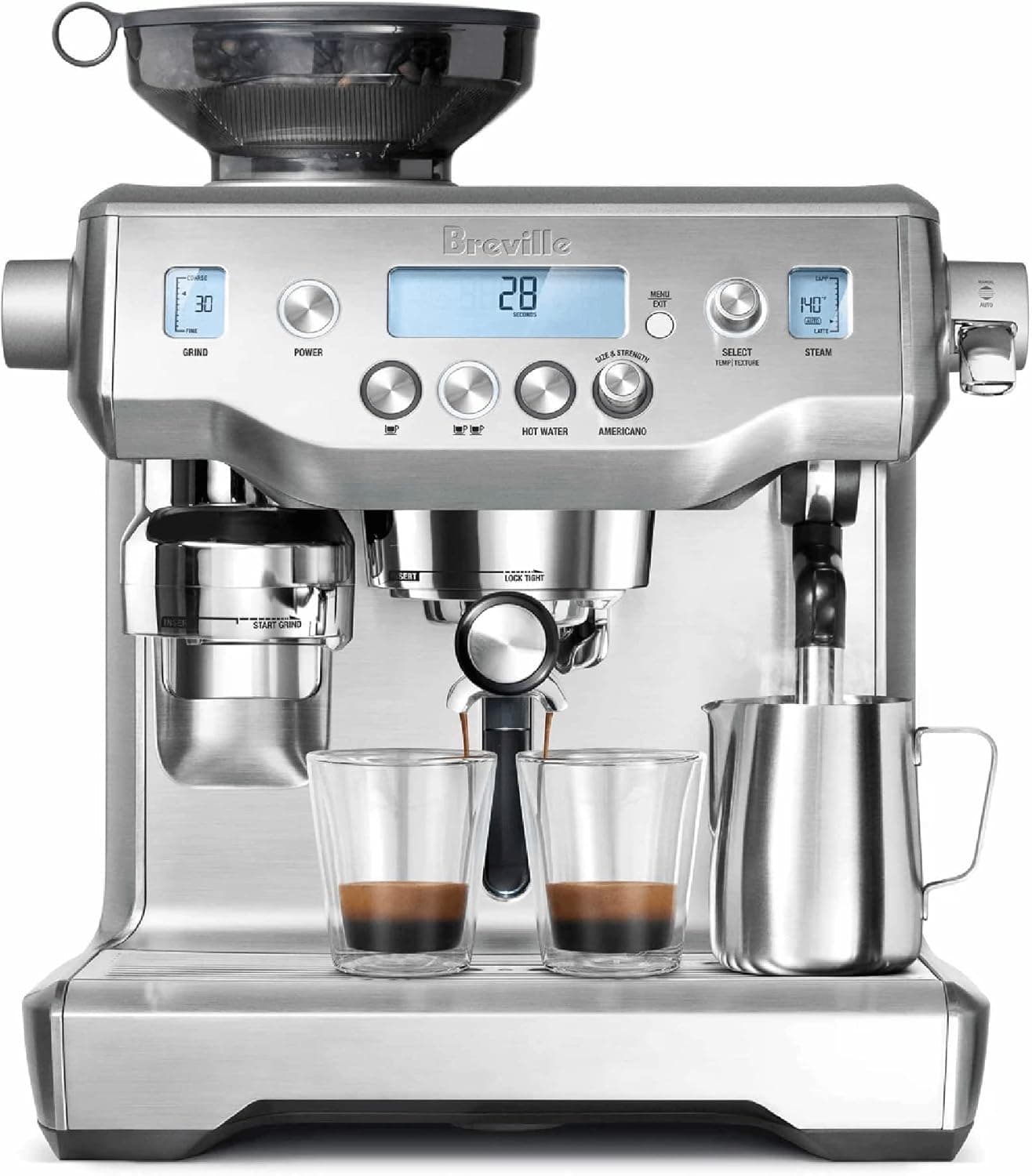
- Boilers: Two stainless steel, both PID-controlled; brew boiler about 450ml (15 fl oz), steam boiler about 950ml (32 fl oz)
- Simultaneous brew and steam: Yes, a genuine dual-boiler design rather than one boiler switching roles
- Full drink time: Roughly 60 to 90 seconds, grind through milk, per one independent estimate
- Grinder: Integrated conical burr, Baratza-designed, 45 grind settings plus 10 additional fine-adjustment steps on the inner burr
- Portafilter: 58mm, the commercial standard
- Automation: Automatic dosing and tamping station
- Interface: Full-color touchscreen with automatic mode and a separate manual mode (swipe up), exposing a pressure gauge, time-based dosing, pre-infusion timing, and a bloom function
- Milk system: Auto MilQ automatic frother with a temperature probe, adjustable by hand
- Water tank: About 84 oz. Bean hopper: About 12 oz
- Pump: Vibratory, 9-bar at the puck
- Sold internationally as: The Sage Oracle Touch (SES990), identical internals
I checked this list directly against this site's own product data for the Oracle Touch, and one line there deserves a flag rather than a quiet correction. The existing pros list states the price is "difficult to justify against semi-auto machines with full manual control at a fraction of the cost," and that's a fair, defensible framing worth keeping. Everything else in that entry, the dual-boiler claim, the auto dose/grind/tamp workflow, the 58mm portafilter, and the touchscreen, lines up with what I found independently, so I'm not flagging any conflict there.
The dual boiler: actual simultaneous brewing and steaming
Most machines in this category, including plenty that call themselves "dual boiler" loosely, still make you choose between brewing and steaming in some sequence. The Oracle Touch doesn't. It runs two genuinely separate stainless steel boilers, each with its own PID control loop, a roughly 450ml brew boiler and a roughly 950ml steam boiler. Because they're independent, the machine can pull a shot and texture milk in the same window rather than finishing one before starting the other.
That matters more for a household making back-to-back drinks than it does for someone pulling a single solo espresso each morning. One independent estimate puts a full drink, from grinding through a finished milk-based pour, at roughly 60 to 90 seconds. Whether that number holds for you depends on how quickly you work through the manual parts of the process, but the mechanical bottleneck other single-boiler and thermoblock machines have, waiting for the system to switch modes, simply isn't present here.
The grinder, and the dosing variance worth knowing about
The integrated conical burr grinder uses Baratza-designed burrs and offers 45 grind settings, with an additional 10 fine-adjustment steps on the inner burr for finer resolution than the main dial alone provides. Two independent sources confirm the 45-setting figure, which puts real distance between this grinder and the 30-setting grinders on Breville's own Barista Pro and Barista Touch.
Here's the caveat that matters. Coffeedant's testing found grinder dosing can vary by about ±2g shot to shot on the automated workflow. On a machine that automates grinding, dosing, and tamping specifically to remove variability from your morning, a couple of grams of swing shot to shot is a real, documented frustration, not a nitpick. For someone who just wants a good latte without fuss, it likely won't register. For someone treating this as a precision instrument, and the 45-setting grinder and manual mode both suggest that's who Breville is courting, it's worth weighing a kitchen scale into your routine, at least while dialing in a new bag of beans.
Manual mode: the real differentiator from a purely automatic machine
This is where the Oracle Touch earns its place next to genuinely automatic machines rather than getting lumped in with them. Swipe up on the touchscreen and the interface switches from automatic mode into a manual one that exposes a pressure gauge, switches the grinder from volume-based to time-based dosing, and hands you direct control over pre-infusion timing and a bloom function.
That's a meaningfully different proposition than a one-button super-automatic. In automatic mode, you're getting the guided, hands-off experience the touchscreen is built around. In manual mode, you're adjusting the same variables a semi-automatic machine's owner adjusts by feel, just with a pressure gauge on screen instead of guesswork. Whether that's a feature you'll use regularly or one you'll try twice and abandon depends on how much you want to be involved in the process, but the option existing at all separates this machine from anything that only ever runs one way.
Auto MilQ: automatic milk, with room to adjust
Breville's Auto MilQ system handles milk texturing automatically, using a temperature probe to track where the milk is headed and stop at the right point. Unlike a fully sealed automatic system, you can still adjust the output by hand rather than accepting whatever the default program gives you.
That combination, automatic by default with room to customize, mirrors the philosophy running through the rest of the machine. You're not choosing between "automatic" and "manual" as a permanent identity for how you use the Oracle Touch. You're choosing per drink, per morning, depending on how much attention you want to give it.
Possible discontinuation: a single-sourced claim worth flagging
Here's the part of this review I'd rather flag clearly than bury. CoffeeKev's detailed review states that Breville has discontinued both the Oracle and the Oracle Touch, replacing them with the Oracle Jet and the Oracle Dual Boiler. Listings for the Oracle Touch may still appear on Breville's own site and through retailers while existing stock lasts, but if this account is accurate, you could be buying into the tail end of a product line rather than a machine Breville intends to keep supporting and stocking long-term.
I'm treating this as a single-source claim rather than settled fact, the same way this site handled a similar discontinuation question on the Philips 3200 LatteGo. One detailed, credible reviewer stating something plainly is a real signal, but it's not the same as multiple independent sources confirming it or an official statement from Breville itself. If you're shopping for an Oracle Touch right now, check current stock and listing language carefully, and go in aware that this could be a legacy purchase rather than an ongoing product line.
One thing worth being precise about: the newer Oracle Jet and Oracle Dual Boiler are different machines with different feature sets, not simply renamed Oracle Touches. Anything reported specifically about those models, including an "Auto Dial-in" feature and grind-consistency complaints associated with it, belongs to those machines and shouldn't be read back onto the Oracle Touch covered here. The dosing variance discussed above is the Oracle Touch's own documented issue, separate from whatever the newer machines are dealing with.
Breville Oracle Touch vs Breville Barista Touch
The Breville Barista Touch is the natural step-down comparison within Breville's own lineup, and the gap between them is bigger than the shared "Touch" name suggests. The Barista Touch runs a single ThermoJet heating system, a 30-setting grinder, a 54mm portafilter, and an auto steam wand, all genuinely good, at a fraction of the Oracle Touch's price.
The Oracle Touch answers with real dual-boiler simultaneous brew and steam instead of ThermoJet's fast-but-sequential heating, a 45-setting grinder against the Barista Touch's 30, a 58mm commercial portafilter instead of 54mm, automated tamping the Barista Touch doesn't attempt, and a manual mode with a pressure gauge that the Barista Touch has no equivalent for. If you want Breville's automation philosophy without spending flagship money, the Barista Touch remains the stronger value. If you want the commercial-adjacent portafilter size, the extra grind resolution, and true simultaneous operation, the Oracle Touch is what that additional money buys.
Breville Oracle Touch vs De'Longhi Magnifica Evo
The De'Longhi Magnifica Evo sits at the opposite end of the automatic-machine spectrum, a genuinely sealed one-touch super-automatic with no manual mode to swipe into. Its conical burr grinder and automatic milk carafe cover daily espresso and cappuccino competently, at a small fraction of the Oracle Touch's price, with none of the setup or dial-in the Oracle Touch's grinder and portafilter demand.
What the Magnifica Evo can't offer is a 58mm portafilter, a real pressure gauge, or any path back to manual control if you ever want one. The Oracle Touch is built for someone who wants the option to graduate into manual technique without buying a second machine. The Magnifica Evo is built for someone who never wants that option in the first place. Neither approach is wrong, they're just answering different questions about how involved you want to be.
Who should buy the Breville Oracle Touch
Buy it if you want genuine simultaneous brewing and steaming, a 58mm portafilter's accessory ecosystem, and the flexibility to run fully automatic most days while keeping a real manual mode available for when you want it, and you're comfortable weighing the dosing-variance caveat and the discontinuation question against everything the machine does well.
Skip it if perfectly repeatable dosing to the gram matters more to you than convenience, since the ±2g variance Coffeedant measured runs counter to that goal. Skip it too if you'd rather buy into a product line Breville is actively continuing rather than one that may be winding down, in which case it's worth pricing out the Oracle Jet or Oracle Dual Boiler directly before committing here.
Is the Breville Oracle Touch discontinued?
Possibly, but this isn't settled fact yet. One detailed, credible independent review, from CoffeeKev, states that Breville has discontinued the Oracle and Oracle Touch in favor of the newer Oracle Jet and Oracle Dual Boiler. I found this claim in a single source, so I'm treating it as a strong signal rather than confirmed fact. Listings for the Oracle Touch may still be available directly from Breville and through retailers while stock lasts. If you're shopping for one now, check current availability carefully and consider comparing it against the Oracle Jet and Oracle Dual Boiler before deciding.
Does the Oracle Touch have a manual mode?
Yes, and it's one of the machine's real differentiators. Swiping up on the touchscreen switches from automatic mode into a manual one that exposes a pressure gauge, switches the grinder from volume-based to time-based dosing, and gives you direct control over pre-infusion timing and a bloom function. That means you're not locked into one-button operation the way you would be on a fully sealed super-automatic. You can run the machine hands-off most days and switch into manual control whenever you want to adjust the process yourself.
Oracle Touch vs Oracle Dual Boiler, what's the difference?
The Oracle Dual Boiler is one of the two newer machines reported to be replacing the Oracle Touch in Breville's lineup, per CoffeeKev's review, alongside the Oracle Jet. I don't have independently verified specifics on how the Oracle Dual Boiler's feature set differs point by point from the Oracle Touch covered in this review, and I'd rather say that plainly than guess. What I can say clearly is that features and criticisms reported about the newer Oracle Jet or Oracle Dual Boiler, including an Auto Dial-in feature and any grind-consistency complaints tied to it, belong to those newer machines specifically and shouldn't be assumed to apply to the Oracle Touch reviewed here.
How many grind settings does the Oracle Touch have?
45 main grind settings, confirmed by two independent sources, plus 10 additional fine-adjustment steps on the inner burr for finer resolution between the main settings. That's a meaningfully wider range than the 30 settings on Breville's own Barista Pro and Barista Touch. The caveat worth knowing alongside that resolution: Coffeedant's testing found the automated dosing can still vary by about ±2g shot to shot, so a wide grind range doesn't fully eliminate the need to check your dose with a scale if precision matters to you.