
How to Descale an Espresso Machine

Jack · Founder & Lead Reviewer
Researches every machine through engineering analysis, long-term owner reports, and independent technical testing, including Italian and German sources most English-language reviews skip.
Last updated
If your shots are running slow and your machine groans louder than it used to, scale is the usual suspect. Learning how to descale an espresso machine is the single most useful maintenance skill a home barista can pick up: it takes about 20 minutes, costs a couple of dollars, and prevents the slow death of your boiler.
Skip it, and minerals keep stacking up inside the water path. Flow chokes, brew temperature drops, and eventually the pump strains against a blocked pipe until it quits. Every machine in our ranking of the best home espresso machines needs this done regularly, no exceptions.
What You Need Before You Start
You have three options for the descaling agent itself:
- Commercial descaling solution, formulated for coffee equipment, rinses clean, and safe for internal seals. The most expensive option, but the only one most manufacturers officially approve.
- White vinegar, cheap and already in your pantry. It dissolves scale, but slowly, and the smell hangs around in the water circuit for a surprising number of shots afterward.
- Citric acid, the budget middle ground. About a tablespoon per quart of warm water, odorless, and it rinses out far cleaner than vinegar.
Beyond that, you need a container large enough to catch a full tank of water (a 32 oz pitcher works), a towel, and 20 minutes when nobody needs coffee.
If you don't keep a descaler in the cabinet, this is the kind we use:
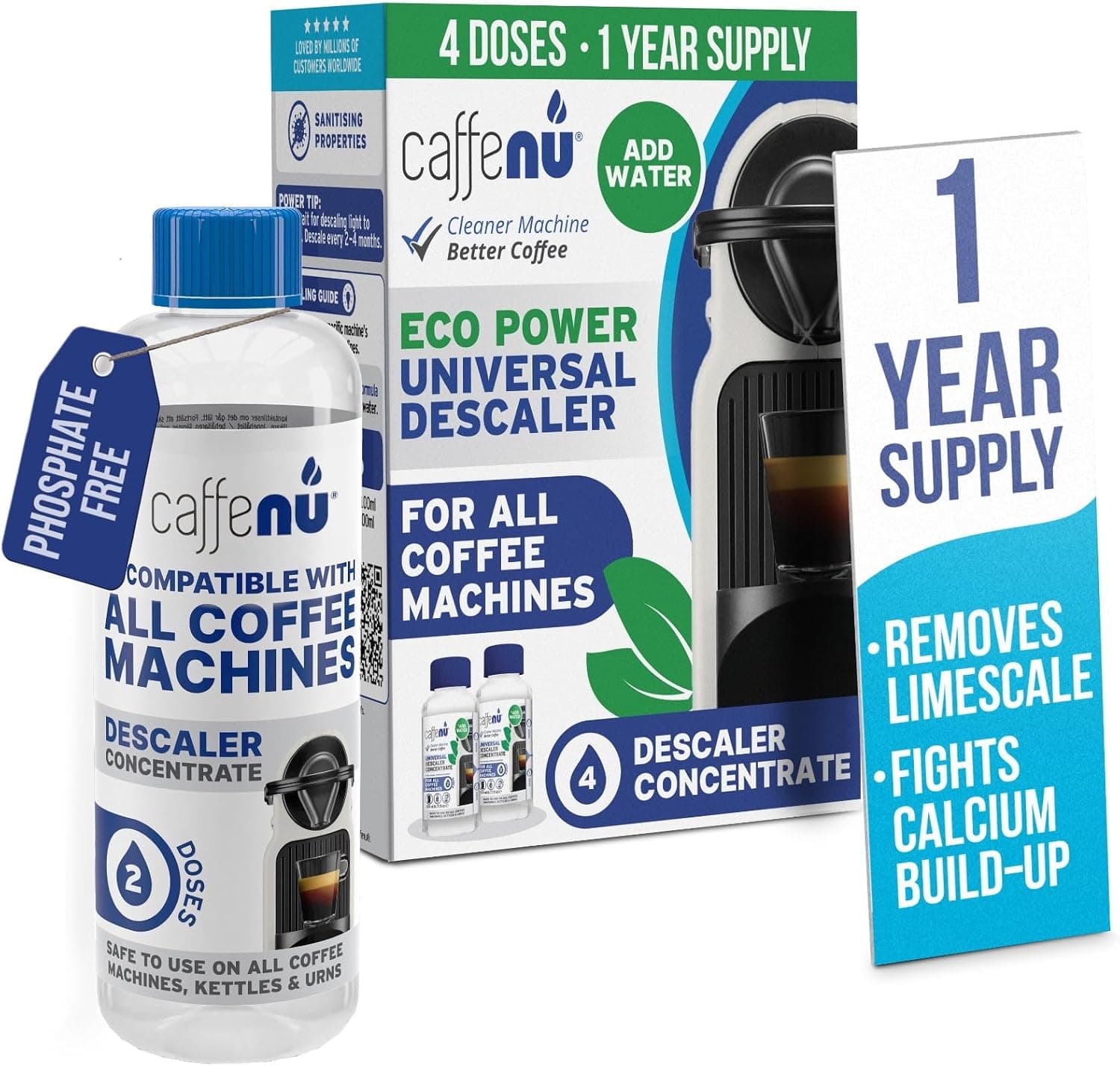
Best for Routine Descaling
How to Descale Your Espresso Machine: Step-by-Step
The same process works for almost every semi-automatic machine. If yours has a built-in descale program, use it, the steps below still tell you what the machine is doing and when to step in.
Step 1: Empty and Rinse the Water Tank
Remove the tank, dump any old water, and rinse it under the tap. If your machine uses a water filter, take it out now, descaling solution will ruin the filter media, and the filter blocks the descaler from working anyway.
Step 2: Mix the Descaling Solution
Fill the tank with warm water and add the descaler at the ratio printed on the package, usually one dose per quart. Lock the tank back in and power the machine on so it heats up.
Step 3: Run the Descaling Cycle
Put your container under the group head and run about half the tank through in 8 oz batches, pausing a few minutes between batches so the solution can sit in the boiler and work. Then purge the rest through the steam wand or hot-water spout, the steam circuit scales up just like the brew path, and skipping it is the most common mistake.
Step 4: Run Two Full Rinse Cycles
Refill the tank with fresh water and run all of it through both circuits. Then do it again with a second full tank. Any descaler left inside will sour your next shot, so don't shortcut the second rinse.
Step 5: Wipe Down and Reassemble
Wipe the drip tray, group head and steam wand, reinstall the water filter, and refill the tank with fresh drinking water. Pull a blank shot (no coffee in the basket), if the water tastes neutral, you're done.
How to Descale a Breville Espresso Machine
Breville machines follow the exact process above, but most models have a dedicated descale mode that controls the timing for you. On the Barista Express, you enter it with a button combination at power-on (2 CUP plus POWER), and the machine meters the solution through the brew head, hot-water outlet and steam wand in sequence. On the Bambino Plus the combination differs, check your manual, because Breville changes it between revisions.
One Breville-specific note: the descale alert is tied to a water hardness setting you chose during setup. If you set it wrong, the machine will nag you too often or not often enough.
For descaling steps specific to Breville machines in practice, our Breville Bambino Plus review covers the process in detail.
How to Descale a De'Longhi Espresso Machine
De'Longhi machines tell you when it's time: an orange descale light comes on and stays on. On models with a dedicated CALC or descale button, hold it until the light flashes, place a container under the spouts, and open the steam knob, the machine pulses the solution through automatically and stops when the tank is empty.
On manual EC-series machines there's no program: run the solution through the brew head and steam knob yourself, exactly as in the step-by-step section above. Either way, finish with two full tanks of fresh water before you trust the next shot.
One quirk worth knowing: on many De'Longhi models the descale light won't turn off until the machine has completed its own counted cycle. If you descaled manually and the light stays on, run the official program with plain water once, it resets the counter without wasting another dose of descaler.
How Often Should You Descale?
Every 2–3 months with normal use, or immediately when the machine alerts you. Two variables move that schedule:
- Water hardness. Hard tap water, common across much of the US , can mean monthly descaling. Filtered or bottled water stretches the interval considerably.
- Usage. Four lattes a day scales a boiler far faster than a weekend-only habit.
If you want a number rather than a range, our descaling calculator works out a personalised interval based on your specific machine, water hardness, and daily cups.
Not sure how hard your water is? A pack of aquarium-style test strips costs a few dollars and settles it in seconds. Anything above roughly 120 ppm counts as hard, put a descaling reminder on your calendar rather than waiting for symptoms, because by the time flow slows down, the buildup is already substantial.
If you're still choosing a machine, this is a real ownership cost worth weighing, the best espresso machines for beginners include super-automatics that run the whole descale cycle for you.
Descaling Solution vs Vinegar. Which Is Better?
For any machine under warranty, use a commercial solution. Several manufacturers explicitly exclude vinegar damage from coverage, and vinegar's acetic acid can degrade rubber seals and gaskets on some machines over repeated use.
If you do descale an espresso machine with vinegar, dilute it 1:1 with water and double your rinse cycles, the taste lingers. Citric acid is the better cheap option: nearly as inexpensive, gentler on seals, and it rinses clean.
Can I use white vinegar to descale my espresso machine?
It works chemically, but it's slower than a proper descaler, the smell lingers in the circuit for many shots, and some manufacturers void warranty coverage if vinegar damage is found. If you use it anyway, dilute it 1:1 and rinse with at least two full tanks.
How do I know when my espresso machine needs descaling?
Slower water flow, cooler shots, a louder pump, white flakes in the drip tray, or a descale alert light. Any one of those means scale has already built up, run a cycle now rather than waiting.
How long does the descaling process take?
About 20 minutes for a semi-automatic: 10 for the descaling solution and 10 for the rinse cycles. Super-automatics with guided programs run closer to 30 minutes, but most of that is hands-off.
Will descaling fix slow water flow?
Usually, if scale was the cause, flow typically improves immediately after the rinse cycles. If shots still run slow afterward, look at your grind setting, a clogged filter basket, or a blocked group head screen instead.