
Smeg EGF03 Espresso Machine Review (2026)

Jack · Founder & Lead Reviewer
Researches every machine through engineering analysis, long-term owner reports, and independent technical testing, including Italian and German sources most English-language reviews skip.
Last updated

Most people who buy a Smeg espresso machine have already decided. They own the toaster. They own the kettle, maybe the fridge too, and they want the full color-matched set sitting on the counter. The EGF03 is built around that decision, not in spite of it. Nobody needs convincing that it looks good, it does. The harder question is whether a premium price that's partly paying for design can also pull a shot worth drinking every morning. This Smeg EGF03 review is built on independent testing, owner reports, and the spec sheet rather than hands-on time with the machine myself, and the flaws show up alongside the parts that hold up.
The verdict up front
Buy this if you already own Smeg appliances and want a real semi-auto with a built-in grinder to match them. Skip it if grinder precision matters more to you than the kitchen aesthetic, the Breville Barista Pro beats it there. It's a genuine espresso machine wearing a design statement, not the other way around.
The design: the actual reason people buy this
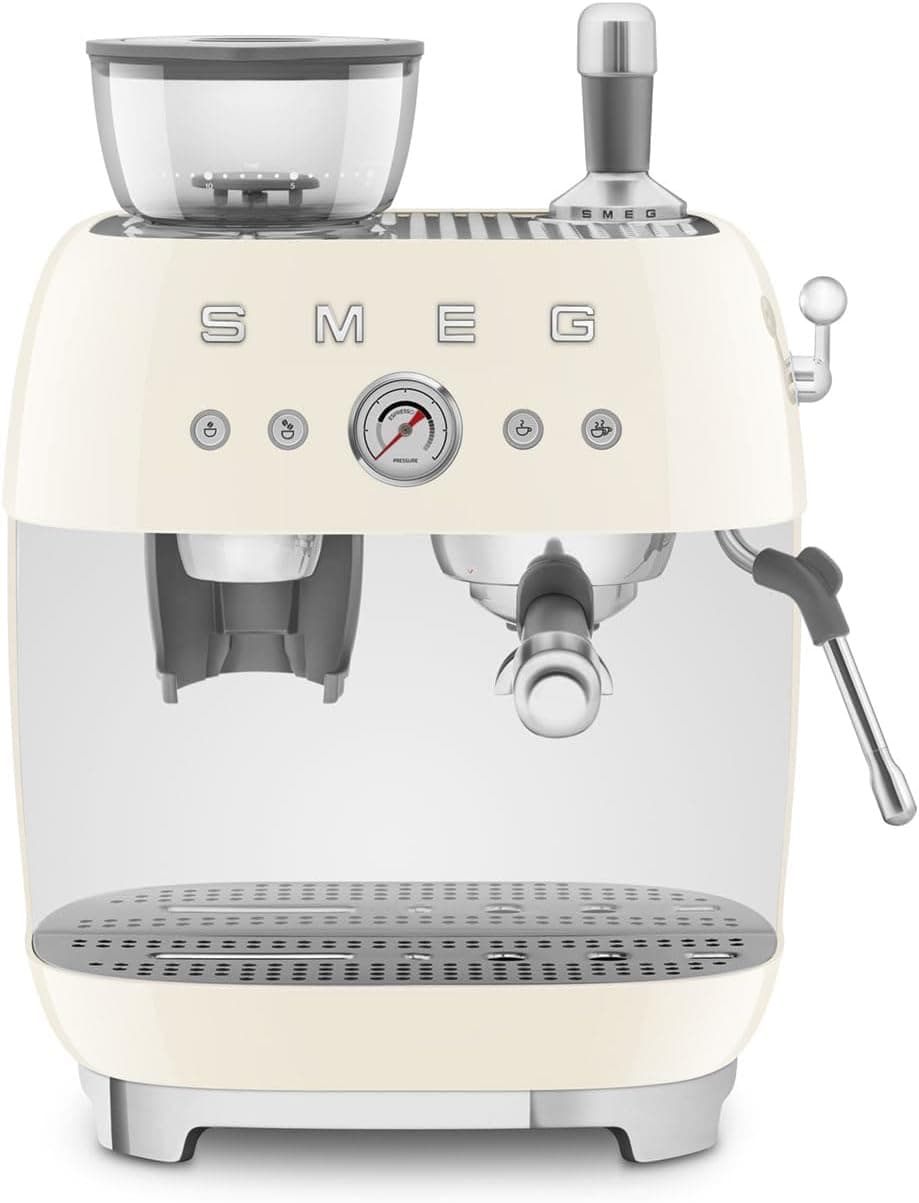
The EGF03 is Smeg's flagship semi-automatic, a Smeg espresso machine with grinder built specifically to match the brand's small-appliance lineup. Its 50s styling isn't subtle, and it isn't trying to be. Die-cast aluminum body, rounded shoulders, chrome accents. Six colors ship: cream, pastel blue, pastel green, red, white, and black, all matched to Smeg's kettle and toaster lineup.
The colored casing is plastic over the aluminum chassis, not solid metal end to end, which is worth knowing since the die-cast body creates an expectation of an all-metal build. The structural frame is aluminum; the color panels are cosmetic plastic over it. The grinder arm swings out to the side, which looks elegant in photos, and multiple reviewers note it scatters a few grounds onto the counter during normal use. The pressure gauge built into the front isn't decoration, more on that below.
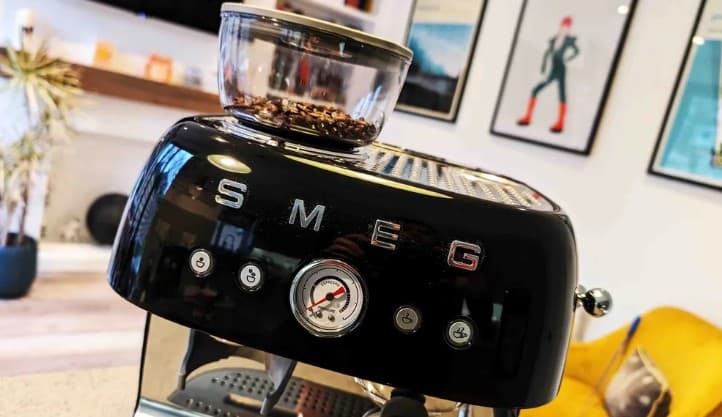
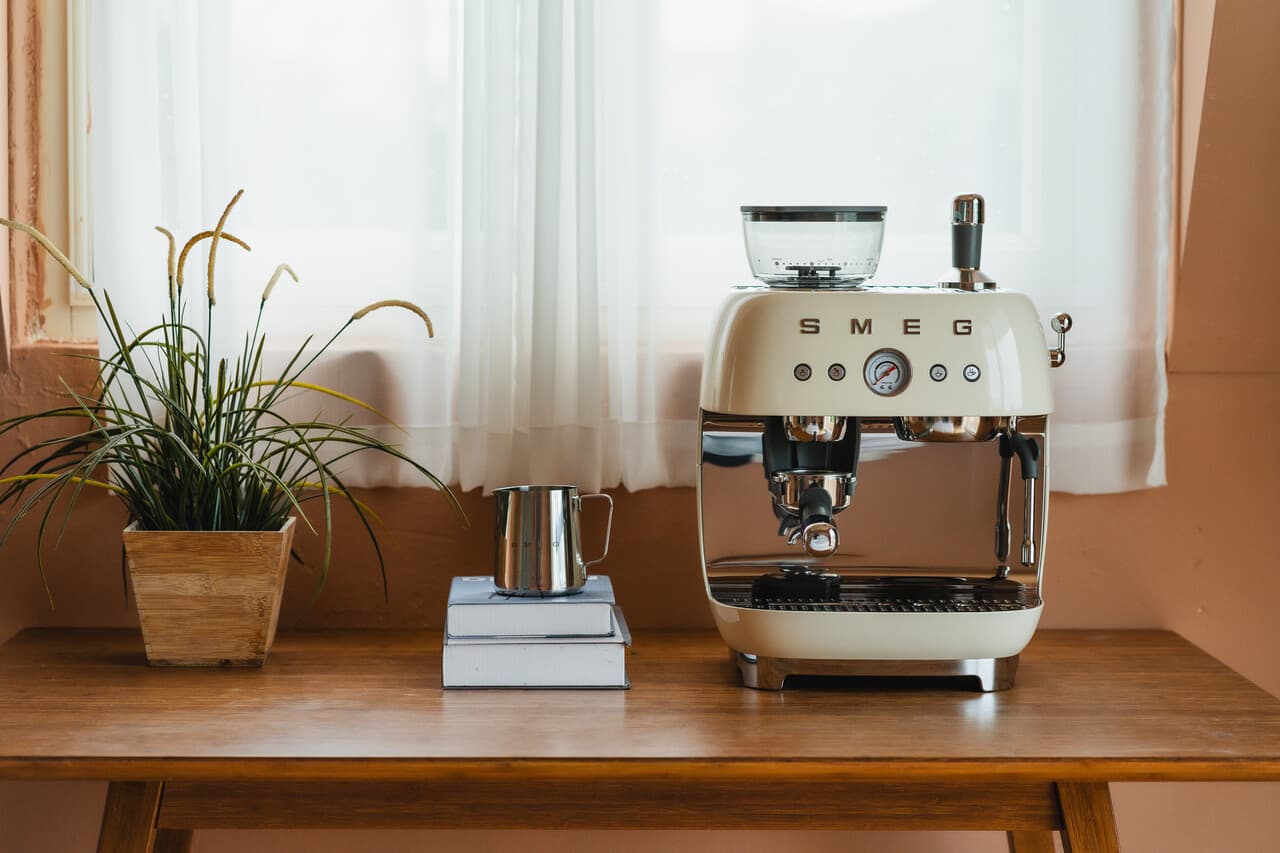
Photos can flatten the rounded shoulders and candy colors into something that reads almost like a toy. Reviewers who've spent time with it in person describe it as heavier and more substantial than product shots suggest, with real resistance in the dials and chrome trim that catches light differently than a photo can capture.
What you actually get
Underneath the styling sits a dual thermoblock system, which heats water for brewing and steaming independently and simultaneously. There's a built-in burr grinder with 15 settings, adjusted via a knob on the hopper itself, feeding a proper 58mm commercial portafilter, larger than the 51-54mm found on most machines in this price range. Three baskets ship in the box: single-wall, double-wall, and a pre-ground bypass filter for when you want to skip the grinder entirely.
You also get four temperature and pre-infusion profiles, a steam wand with two intensity levels, and a metal tamper, when plenty of competitors at this price still ship plastic ones. At this price tier, the EGF03 sits squarely against the Breville Barista Pro and the Rancilio Silvia. That's serious company for a machine people buy partly for its looks.
The bypass basket deserves a mention on its own. It lets you skip the built-in grinder completely and brew with pre-ground coffee, useful for decaf, for a specialty bag you don't want to run through the burrs, or for houseguests who don't know your grind settings. Most bean-to-cup machines at this price force you to use their grinder every time. The EGF03 doesn't, and that flexibility matters more in daily use than the spec sheet suggests.
The pressure gauge: more useful than it looks
Most reviews treat the analog gauge on the front as a retro styling cue and move on. That's a mistake. It reads extraction pressure in real time, letting you see at a glance whether your shot is running in a normal espresso range or drifting too fast or too slow.
Needle low and shot running fast usually means the grind is too coarse, or you're under-dosing. Needle pinned high with the shot barely moving usually means too fine, or too hard a tamp. It functions as a live diagnostic rather than a decoration, and it's one of the more genuinely useful details on a machine priced this high, especially for anyone dialing in a new bag of beans.
How the espresso tastes
The non-pressurized portafilter means real espresso and real crema rather than the foamy approximation some bean-to-cup machines produce. Independent reviews report a mixed picture on the grinding and dosing process itself. TechRadar and other testers describe it as one of the messier parts of daily use: grounds don't always land cleanly in the basket, and getting a consistent dose takes some fussing regardless of the setting. Once dialed in, the consensus across reviews is that the shots hold real crema and a fuller body than the pressurized baskets on cheaper bean-to-cup machines, consistent with what a non-pressurized portafilter should deliver in the first place.
Roast variety matters more here than on a pressurized machine. Darker, oilier beans tend to run without much fuss; lighter, denser roasts benefit more from the pressure gauge's feedback while you're finding the right setting. The dual thermoblocks mean there's no standing around waiting for the boiler to switch from brew to steam once you're ready to move on.
The steam wand and milk
Two steam intensity levels is an unusual feature at this price: low for a single flat white, high when texturing for two drinks back to back. Tom's Guide consistently rates the wand as one of the strongest parts of the machine, describing it as powerful enough to handle back-to-back drinks without losing steam pressure.
Because the second thermoblock handles steam independently, it's ready as soon as you need it: no lag after pulling a shot, no choosing between a hot espresso and properly steamed milk.
The frustrating parts
The programming menu is the EGF03's weakest point. Four small buttons control short, long, and progressive shot presets along with custom volumes, and there's no display anywhere to confirm what you're actually setting. Multiple independent reviewers describe the process as finicky enough that most owners give up and stick with the factory defaults, which extract fine on their own.
The grinder arm is the second annoyance. Reviewers note it swings out elegantly but scatters a handful of grounds onto the counter, worse on the finer settings, so budget a quick wipe-down into the routine. The descale cycle is another planning item: Smeg's own manual puts it at roughly 40 minutes, among the longest in this machine's category. Plan a morning around it rather than discovering the length mid-routine. And again, the colored casing is plastic over the aluminum body, not metal through and through, worth knowing at this price.
None of these are dealbreakers by themselves, but reviewers who've lived with the machine longer term say they add up over time. The menu issue is the one I'd weigh most heavily, since it's purely a software and layout choice: there's no technical reason four buttons and a couple of LEDs couldn't have been designed more clearly. The grounds and the descale time are physical limitations you learn to work around. The confusing menu reads like a design choice nobody prioritized fixing.
Smeg EGF03 vs Breville Barista Pro
Both machines sit in a similar premium bracket, and both are semi-automatic with a built-in grinder. From there they diverge.
The Smeg gives you six color options, a dual thermoblock, a working pressure gauge, and Italian design heritage, but the side-swinging grinder arm needs more counter clearance and the programming is genuinely confusing. The Breville counters with 30 grind settings against the Smeg's 15, an LCD display that makes presets easy to set, and no color choices, just steel. Buy the Smeg for the aesthetics, or because you're already in the Smeg ecosystem. Buy the Breville if grinder precision and straightforward controls matter more than how it looks.
Measure your counter space either way, since the grinder arm needs clearance to swing out. Price wise, the gap between the two is usually modest enough that it shouldn't be the deciding factor: the Smeg tends to sit a bit higher, mostly for the looks and the dual thermoblock. The Rancilio Silvia is the other serious option at this price tier, though it skips the built-in grinder entirely in favor of a no-frills single boiler. For the full lineup at every price point, see our best espresso machines guide.
Colors: which Smeg EGF03 should you buy?
All six colors, cream, pastel blue, pastel green, red, white, and black, are identical in specs and performance. There's no "better" color here, just whichever one matches your kitchen or the rest of your Smeg lineup. Cream and pastel blue tend to be the most commonly chosen colors, based on what shows up most often in reviews and owner photos. One practical note: confirm you're buying the 120V US version, since Smeg sells this machine globally with different voltage configurations.
How to descale and use the Smeg EGF03
Getting started is simple: fill the water tank, insert the portafilter, and run a warm-up flush before your first real shot of the day. That clears any stale water and gets the group head to temperature.
Descaling is the part to plan for. The machine alerts you when it's due, and the cycle itself runs close to 40 minutes using a Smeg-recommended solution or citric acid. Don't start it five minutes before you need to leave the house. The full manual, including the more detailed Italian-language version, is available on Smeg's site, and replacement baskets and cleaning accessories are sold directly through Smeg as well.
Who should buy the Smeg EGF03?
Buy it if you already own other Smeg appliances and want a matching set, you care about Italian design heritage, or you want a genuine semi-auto with a dual thermoblock and 58mm portafilter at this price.
Skip it if you want the best grind control in the class, the Breville Barista Pro wins there, your kitchen counter is tight, since this machine takes up real space, or a confusing button-driven menu is going to bother you every single morning.
Is the Smeg EGF03 worth the money?
Yes, if you're buying it for both reasons people actually buy it: the look and the espresso. At this price tier you get a real dual thermoblock system, a 58mm commercial portafilter, a built-in 15-setting grinder, and a metal tamper, hardware that competes directly with the Breville Barista Pro and Rancilio Silvia. The catch is the programming menu, which is genuinely confusing without a display, and a casing that's plastic over aluminum rather than solid metal. If you can live with sticking to the default presets, independent reviews describe the shots themselves as excellent.
What's the difference between the Smeg EGF03 and ECF02?
The ECF02 is Smeg's simpler manual machine: no built-in grinder, three-button operation, and a noticeably lower price point. The EGF03 adds a built-in burr grinder with 15 settings, a dual thermoblock for simultaneous brewing and steaming, four temperature and pre-infusion profiles, and a pressure gauge, all of which push the price well above the ECF02. If you already own a separate grinder or want the simpler machine, the ECF02 is the better value. If you want grinder and machine in one box, the EGF03 is the step up.
How do you descale the Smeg EGF03?
The machine alerts you when descaling is due. Run the built-in descale cycle using either Smeg's recommended descaling solution or a citric acid mix, following the prompts on the machine. Budget close to 40 minutes for the full cycle, confirmed in Smeg's own manual, which is longer than most competitors in this category. Plan it for a morning when you're not in a rush, since you can't brew during the cycle.
What colors does the Smeg EGF03 come in?
Six colors: cream, pastel blue, pastel green, red, white, and black. All six share identical specs and performance, the grinder, dual thermoblock, and portafilter are the same across every color. Pick based on your kitchen palette or to match other Smeg appliances you already own; cream and pastel blue tend to be the most popular choices.