
Breville Barista Pro Review (2026)

Jack · Founder & Lead Reviewer
Researches every machine through engineering analysis, long-term owner reports, and independent technical testing, including Italian and German sources most English-language reviews skip.
Last updated
 4.6
4.6
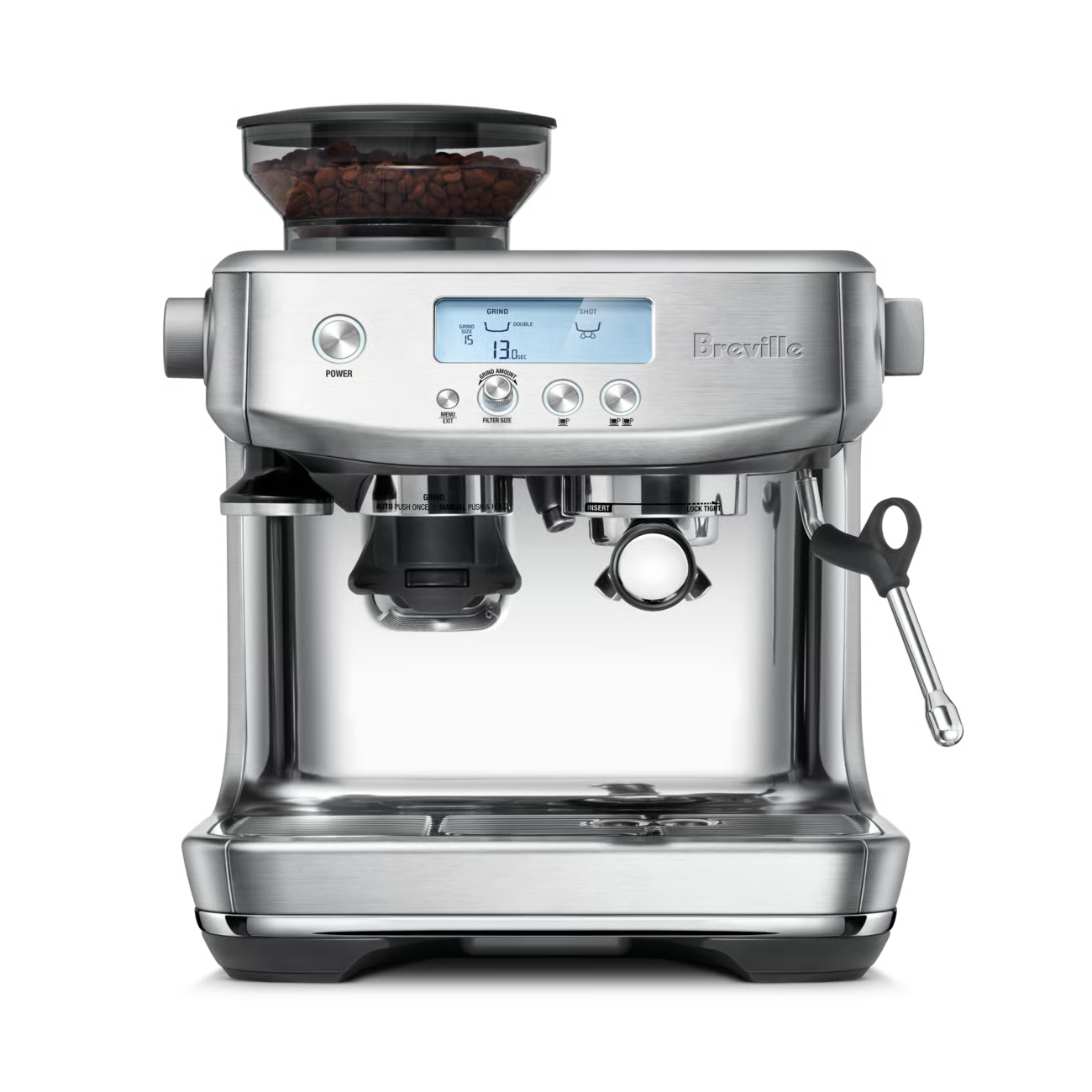
Call it Breville's worst-kept secret: after acquiring Baratza for $60 million in 2020, newer Barista Pro units quietly got better burrs. Not on the box. Not in the product description. But if you're buying a BES878BSS from around 2023 onward, you're getting Baratza-designed European Precision Burrs, the same M2 burr set that goes into the Baratza Virtuoso, inside what's already Breville's most capable all-in-one machine.
The Barista Pro costs a step more than the standard Barista Express and a smaller gap over the Barista Express Impress. Most comparisons focus on the ThermoJet heat-up. That's real and it changes the morning workflow in ways the spec sheet doesn't fully convey. But the grinder is the stronger argument. Thirty settings, Baratza burr geometry on current units, and resolution that the Express can't match at the fine end of the dial.
The verdict up front
The Barista Pro is the right buy for two specific buyers: someone who values fast morning workflow and won't compromise on it, and anyone dialing in light or medium roasts who needs the grinder resolution the Express doesn't offer. For everyone else, the math deserves scrutiny.
ThermoJet: the 3-second heat-up (and its catch)
The ThermoJet is a different heating architecture from the Thermocoil in the Express line, not just a faster version of the same thing. Where a Thermocoil acts as a heat reservoir, holding temperature in a coiled copper tube, the ThermoJet passes water through a thin high-surface-area metal path and heats it almost instantly. From cold start to brew-ready: three seconds. Compare that to about 30 seconds for the Barista Express.
That changes the daily routine more than the spec implies. No pre-heating ritual. No wondering if the machine is warm enough yet. You fill the portafilter, press the button, and it's ready. For single-drink weekday mornings especially, this is a genuine quality-of-life shift.
Here's the catch. The ThermoJet's low thermal mass means the group head, the metal housing the portafilter locks into, takes a beat longer to reach full temp than the water does. On a cold start, run a 2-second blank flush through the group head before your actual extraction. It brings everything to temperature. Skip it and your first shot is measurably cooler than subsequent ones. Two seconds. Worth doing every time.
For back-to-back sessions making multiple drinks, a short pause between cappuccino cycles lets the thermal system settle. In practice this only matters if you're making four or five drinks in sequence, for most mornings, not an issue.
The secret grinder upgrade nobody talks about
Thirty grind settings. Start there. The Barista Express Impress runs 25; older Express models offer fewer grind settings than the Pro's 30. Thirty settings give meaningful resolution at the fine end of the dial, the end that matters most for espresso, where a single step can shift extraction time by three or four seconds.
The second part of the story is the burrs themselves. Breville's 2020 acquisition of Baratza eventually showed up in the hardware. Units manufactured from approximately 2023 onward ship with what Breville markets as European Precision Burrs. These match the Baratza M2 burr specification used in the Virtuoso and Encore ESP. Better particle size distribution, less spread between fine and coarse particles in the same grind, cleaner flavor separation on medium and light roasts.
Breville doesn't highlight this on the box, but the M2 burr specification has been confirmed by reviewers including CoffeeGeek on production units from 2023 onward, and it matters if you care about what's actually grinding your coffee.
One real limitation: grind retention. After each dose, a small amount of coffee remains in the chute. It stales before your next session and mixes in on the first grind. The fix: run the grinder for 1–2 seconds before dosing to flush the retained grounds out first. A small amount of coffee is wasted. It becomes automatic quickly. Not a dealbreaker, but something every owner should know.
How the espresso tastes
With the upgraded burrs and 30 settings dialed in, the shots are consistently good. Thick crema on medium roasts, balanced acidity, with the conventional 1:2 ratio landing in about 25 to 30 seconds once dialed in. With 30 settings, dialing in a given bag is realistic rather than approximate, and once it's set the grinder repeats the dose reliably from shot to shot, a consistency that Coffeeness's independent testing also confirms.
The 54mm portafilter and nine-bar extraction are standard across the Breville lineup. Single-wall and dual-wall baskets ship in the box. The single-wall is what you want for serious extraction; the dual-wall is the forgiving pressurized option for anyone still finding their feet.
Temperature is adjustable here. The Barista Pro has PID temperature control with a selectable shot temperature, a real step up from fixed-temperature machines, and the LCD shows the extraction temperature as you brew. For very light, Nordic-style roasts, the bigger limit is the built-in grinder rather than the temperature system.
The steam wand and milk
The steam wand is manual, fully articulating, and properly powerful. It produces proper microfoam with a little practice, well-suited to latte-art work.
One detail worth noting: the rubber grip on the wand. When you flush hot milk residue after steaming, the spray from a powerful purge goes toward the grip if you're not holding a cloth below it. That's just the physics of a capable wand, not a design problem. Hold a cloth underneath when you purge. Becomes habit within a few days.
Like every machine at this price point, steam and brew are sequential: the ThermoJet switches modes between them. For two cappuccinos it's fine. For five in a row it's noticeable. That's a single-boiler limitation, not a Barista Pro issue specifically.
Barista Pro vs Barista Express
The comparison that dominates the Breville forums. Here's what actually matters.
The Pro: ThermoJet (3-second heat-up), 30 grind settings, LCD showing extraction temperature. The Express Impress: Thermocoil (about 30 sec), 25 settings, analog pressure gauge, auto-dosing and auto-tamping.
The analog pressure gauge on the Impress is genuinely useful for beginners: it shows what correct extraction pressure looks like in real time, which accelerates learning. The LCD on the Pro shows temperature instead, useful for a different reason, at a different stage of the learning curve.
Is the Pro worth $60 more than the Impress and $150 more than the standard Express? Yes if heat-up speed and grinder resolution are your priorities. The 30 settings make a real difference when you're chasing a specific extraction on a light roast. No if you're newer to espresso and would learn more from the pressure gauge, or if auto-tamping matters to you, which the Breville Barista Express Impress handles well for $60 less.
Worth mentioning: the Breville Bambino Plus has the same ThermoJet speed and a smaller footprint. A Bambino Plus plus a separate entry grinder lands at a broadly similar total, while giving you a better grinder than the built-in one, but with two devices to manage. Different tradeoff, right for different buyers. For how all three compare in context, my best espresso machines guide maps it out.
Barista Pro vs Barista Touch
The Barista Touch (BES880BSS) costs noticeably more. It adds a color touchscreen and automated milk texturing presets on top of the Pro's core hardware. Same ThermoJet, same grinder, and both have adjustable PID temperature.
The Pro is manual controls plus the LCD; the Touch automates the milk side and handles one-touch drink programming. If you want to dial in and control everything yourself, the Pro saves $100–150. If you want a machine that handles milk texture automatically for multiple household members who won't dial anything in, the Touch earns its premium. The hardware underneath is essentially identical.
How to flush, descale, and maintain it
The flush: on a cold start, run a 2-second blank shot through the group head. This brings the group head to brew temperature before your extraction. It's quick, it noticeably improves the first shot of the day, and it becomes a two-second habit. Worth doing every morning.
Descaling: the Barista Pro uses the same entry sequence as the Barista Express, press and hold 2-CUP + POWER simultaneously to enter descale mode. The solid CLEAN/DESCALE light is the descale alert; the flashing CLEAN/DESCALE light means the cleaning cycle (backflush) is due. These are different procedures. For the full step-by-step with button combos for every Breville model, see my how to descale your Breville guide.
Routine maintenance: flush the group head after each shot, purge and wipe the steam wand immediately after frothing, brush the grinder chute after every session to clear retained grounds. For the complete daily, weekly, and monthly cleaning routine, including the backflush cycle and grinder care, see my how to clean your Breville guide. The BES878BSS manual is available on Breville's website; 54mm replacement baskets and water filters are widely available across the Breville accessory ecosystem.
Who should buy the Breville Barista Pro?
Buy it if: a fast morning heat-up is a genuine daily priority, you want grinder resolution to properly dial in light and medium roasts, and you prefer manual control with an LCD readout over automated tamping. The Baratza burr upgrade on current units makes it a stronger case than the spec sheet alone suggests.
Skip it if: budget is the main concern, the Barista Express Impress does 90% of this for $60 less with auto-tamping. Skip it if you want hands-free milk and a touchscreen (the Barista Touch) or the ability to brew and steam at the same time (a dual-boiler machine). Or if you'd rather build a Bambino Plus plus separate grinder setup for a different performance ceiling at a similar total spend.
What's the difference between the Breville Barista Pro and Barista Express?
The Barista Pro uses ThermoJet heating, brew-ready in 3 seconds versus about 30 seconds for the Barista Express's Thermocoil. The Pro has 30 grind settings; the Barista Express Impress runs 25, and older Express models have fewer. The Pro's LCD shows extraction temperature; the Express Impress shows extraction pressure on an analog gauge, which is more useful for beginners learning what correct pressure looks like. Worth the upgrade if heat-up speed and grinder resolution matter. Save the money if you're learning and would benefit from the pressure gauge feedback, or if auto-tamping is a priority.
Why do I need to flush the Breville Barista Pro?
The ThermoJet heats water almost instantly, but the group head, the metal block the portafilter locks into, takes slightly longer to reach full brew temperature on a cold start. Running a 2-second blank flush through the group head before your first extraction brings everything to temp. Skip it and your first shot is measurably cooler than subsequent ones. To flush: press the brew button with an empty basket (no coffee), let water run for about 2 seconds, then lock in your loaded portafilter and pull. Once it's habit it adds no real time to the routine.
What size portafilter does the Barista Pro use?
54mm. Breville's standard across the Bambino Plus, Barista Express, and Barista Pro lines. It's not the 58mm commercial standard used by machines like the Gaggia Classic Pro or Rancilio Silvia. Aftermarket 54mm baskets are available from IMS, Pullman, and Weber, but the selection is narrower than the 58mm ecosystem. The machine ships with both single-wall and dual-wall baskets in the box. Use the single-wall for serious extraction; the dual-wall for more forgiving pressurized shots while you're dialing in.
Does the Barista Pro have a PID?
Yes. The Barista Pro has PID temperature control with an adjustable shot temperature, and the LCD shows the extraction temperature as you brew. That puts it ahead of fixed-temperature machines like the Bambino, where you can't change the brew temperature. For very light roasts, the practical limit is the built-in grinder, not the temperature system.