
How to Descale a Breville Espresso Machine

Jack · Founder & Lead Reviewer
Researches every machine through engineering analysis, long-term owner reports, and independent technical testing, including Italian and German sources most English-language reviews skip.
Last updated
Scale is the number one killer of espresso machines. It works slowly and quietly, mineral deposits from hard water accumulate inside the boiler and water path, choking flow, dropping brew temperature, and eventually grinding the pump to a halt. A Breville Bambino Plus costs $499. A Barista Express Impress runs nearly $800. Neither is worth losing to a problem that takes 15 minutes and a few dollars of descaling solution to prevent.
This guide covers every common Breville model with the exact button combinations: the Barista Express, Barista Express Impress, Barista Pro, Bambino Plus, Bambino, Barista Touch, and Oracle Touch. Find your model and skip straight to its section. For the general principles behind descaling, how scale forms, how descalers work chemically, and the full solution comparison, see our broader how to descale an espresso machine guide.
When Does a Breville Need Descaling?
Every 2–3 months is the baseline for most households. Water hardness moves that number considerably.
Breville machines track scale accumulation against the water hardness setting you chose during initial setup. Hard tap water, common across much of the US at 120+ ppm, can push the alert to monthly or even faster. Filtered or softened water stretches the interval to 3–4 months. If you're not sure how hard your water is, a pack of aquarium test strips costs a few dollars and gives you an answer in seconds. If you'd rather have a calculated schedule, our descaling calculator factors in your Breville model, water hardness, and how many cups you pull each day.
Each model signals the need differently, and getting this wrong is the most common Breville maintenance mistake:
- Barista Express and Barista Pro: a solid CLEAN/DESCALE light illuminates. This is the descale alert. A flashing CLEAN/DESCALE light on these models means the machine wants a backflush cleaning cycle, not descaling. These are different procedures with different solutions. Confusing them is extremely common and wastes cleaning tablets on a problem that needs descaler.
- Bambino Plus: the 1-CUP, STEAM, and 2-CUP buttons all flash simultaneously in an alternating pattern.
- Bambino (standard): the 2-CUP button flashes.
- Barista Touch, Oracle Touch, and other LCD models: an on-screen descale notification appears in the maintenance menu.
Don't wait for symptoms like slower flow or cooler shots. By the time those show up, the buildup is already substantial and the pump has been working harder than it should for weeks.
What You Need
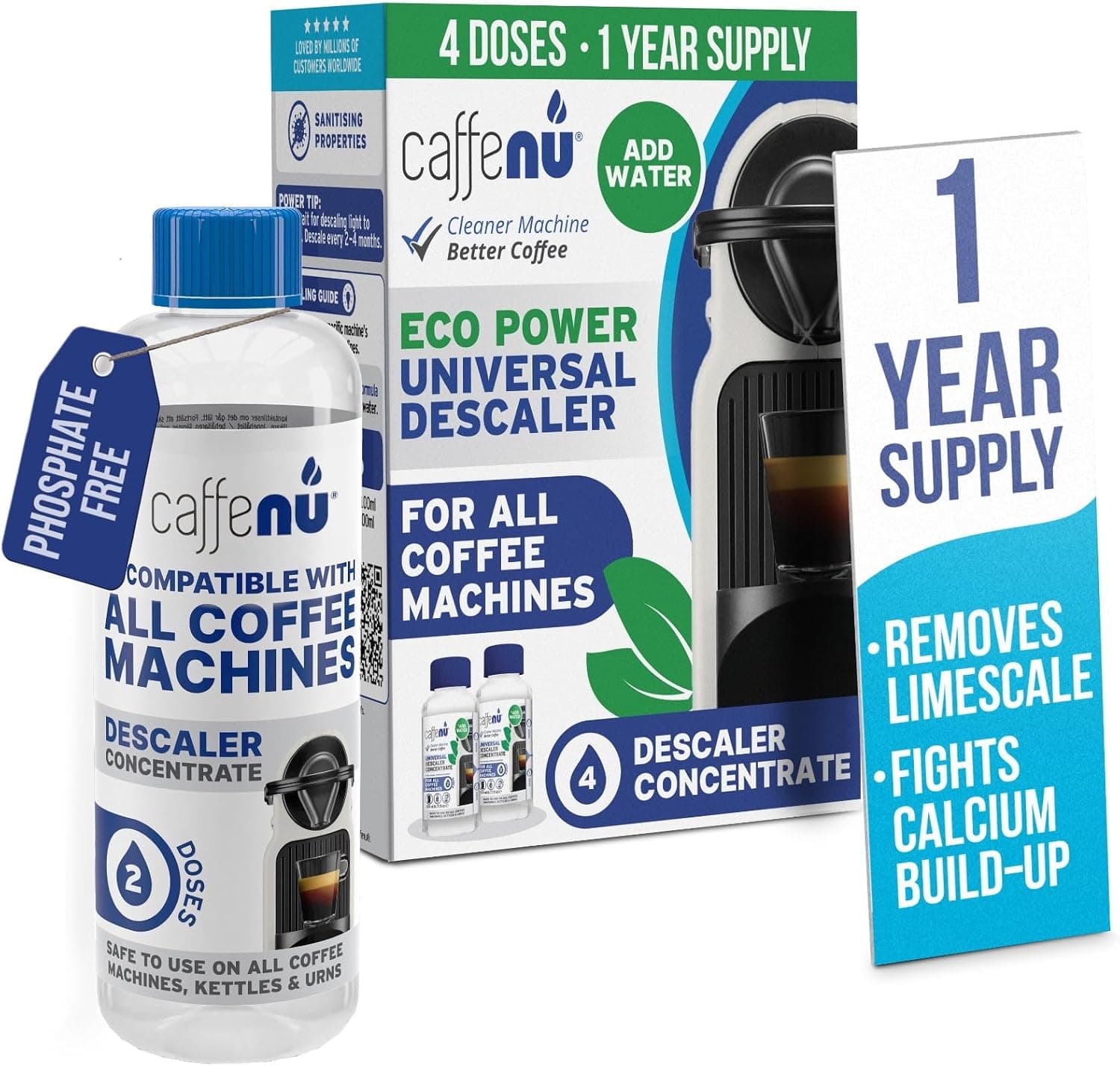
- Descaling solution or powder: Breville's own branded formula, any food-safe coffee machine descaler, or citric acid powder (roughly 1 tablespoon per quart of warm water). Commercial solutions are the safest choice for machines under warranty.
- White vinegar (alternative): works but comes with trade-offs, more on this below.
- A 2-liter or larger container: to catch runoff from the portafilter and steam wand. A mixing bowl works; a large measuring pitcher is ideal.
- Fresh water: you'll run at least two full tanks through after the descaling cycle.
- 15–20 minutes when nobody else needs coffee.
Remove the water filter before you do anything else. Descaling solution destroys the filter media, and the filter physically blocks the descaler from reaching the scale buildup. This step gets skipped constantly, don't skip it.
Best for Routine Descaling
Before You Start: The 5-Minute Rule
Breville machines automatically exit descale mode if they sit idle between steps for too long, typically around 5 minutes. If that happens mid-cycle, the machine doesn't save your progress. You restart from scratch.
Have everything positioned before you enter descale mode: the container is under the portafilter and wand, the solution is mixed, rinse water is ready nearby. Work through each step without stopping and the 5-minute window is a non-issue.
How to Descale the Barista Express and Barista Pro
These models use the same button combination to enter descale mode. The Barista Express Impress uses a slightly different entry (1-CUP + 2-CUP instead of 2-CUP + POWER), check the label on your machine if you're unsure which variant you have.
- Remove the water tank, discard old water, and take out the water filter.
- Fill the tank to the DESCALE line, around 1 liter of warm water with your descaling solution mixed in.
- Position a 2-liter container under the portafilter spout and the steam wand.
- Press and hold 2-CUP + POWER simultaneously to enter descale mode. The POWER, 1-CUP, CLEAN, and STEAM lights will illuminate solid to confirm entry.
- Press 1-CUP to run the descaling solution through the coffee circuit. Wait for this step to finish before moving on.
- Turn the dial right to run the steam circuit, then left for the hot water outlet. Continue until the tank empties.
- Refill the tank with fresh water and run two complete tanks through both circuits.
- Press POWER to exit descale mode and return to normal operation.
For a full look at what makes the Impress different from the standard Express, including how its dosing and tamping system works, see our Breville Barista Express Impress review.
How to Descale the Bambino Plus and Bambino
The Bambino Plus uses a different entry sequence than the Express line. The machine needs to be powered off before you enter descale mode.
- Remove the water tank, discard old water, and take out the water filter.
- Fill the tank to the DESCALE line with your solution.
- Position a 2-liter container under the group head and steam wand.
- If the machine is on: press 1-CUP + STEAM together to power it down. Let it sit for a minute if it was recently brewing, the steam boiler needs to cool before you proceed.
- With the machine off: press and hold 1-CUP + STEAM for 5 seconds. The DESCALE light activates to confirm you're in descale mode.
- Press any button to start the cycle. The machine runs the descaling solution through the coffee circuit automatically, then the steam wand, then the hot water outlet. The full cycle takes around 20–25 minutes.
- Refill the tank with fresh water and run two complete tanks through.
On the standard Bambino (not Plus): the 2-CUP button flashing alone is the descale alert, not the alternating multi-button pattern of the Plus. The descale entry sequence and cycle process are otherwise the same.
For more on the Bambino Plus, including shot quality, the auto steam wand, and the no-grinder tradeoff, see our Breville Bambino Plus review.
How to Descale LCD Models (Barista Touch, Oracle Touch)
The easiest descale process in the Breville lineup.
Navigate to Settings → Maintenance → Descale on the touchscreen. The machine walks you through each step on screen: when to add solution, when to initiate the cycle, when to refill with rinse water, and when the process is complete. The display won't advance to the next step until the current one finishes, you can't miss a step or do them out of order.
Total cycle time for LCD models is typically 20–30 minutes including rinsing. The Oracle Touch, with its dual-boiler system, runs slightly longer than the Barista Touch. Follow the on-screen timing rather than trying to shortcut the rinse phases.
Descaling Solution vs Vinegar
Commercial descaling solution is the right choice for any Breville machine under warranty, and Breville's warranty language specifically covers this. Third-party citric acid-based descalers work identically to Breville's branded formula and typically cost half as much per use. Either keeps your warranty intact.
White vinegar works chemically, acetic acid dissolves calcium carbonate scale, but it runs into three problems. It's slower than a purpose-built descaler. It's harsher on rubber O-rings and seals over repeated use. And it lingers in the water circuit through several shots afterward even after thorough rinsing. A machine that smells like vinegar needs another two rinse tanks before it tastes right.
Citric acid powder is the better cheap alternative. Odorless, gentler on seals, rinses out completely in two tanks. Roughly 1 tablespoon per quart of warm water does the job. For a machine over $400 that you plan to use for years, citric acid is worth choosing over vinegar even if you have to order it online.
If you do use vinegar, dilute it 1:1 with water and plan on three rinse tanks instead of two.
After Descaling: Rinse Thoroughly
Two full tanks of fresh water through both circuits, minimum. Any descaling residue in the water path will sour your first shot after maintenance, and running 15 minutes of work for a coffee that tastes like descaler is a bad outcome.
After the rinse cycles: empty and wipe the drip tray, rinse the container you used for runoff, and reinstall the water filter. Run a blank shot, no coffee in the basket, and taste the water output. Neutral taste means you're done. Any residual chemical taste means another half tank of fresh water through the machine.
Going forward, set a calendar reminder for your next descale cycle rather than waiting for the alert. Monthly for hard water households, every 2–3 months for filtered water. The 15 minutes every few months is a reasonable price for a machine that lasts a decade.
How often should you descale a Breville espresso machine?
Every 2–3 months is the baseline, but water hardness moves that number significantly. Hard tap water (above 120 ppm) can push the interval to monthly; filtered or softened water stretches it to 3–4 months. The machine calibrates its descale alert to the water hardness setting you chose during initial setup, if that setting was wrong, the alert may come too early or too late. Check and reset the water hardness in the settings menu if the timing seems off. Don't wait for slow flow or cooler shots to tell you it's time; by then the buildup is already heavy.
Can you descale a Breville espresso machine with vinegar?
Yes, it works, white vinegar diluted 1:1 with water dissolves scale adequately. The trade-offs: it's slower than a commercial descaler, it's harsher on rubber seals and O-rings over repeated use, and the taste lingers in the water circuit for several shots even after rinsing. If your Breville is under warranty, Breville's warranty language references approved descaling solutions, and using vinegar can complicate a claim if internal seal damage is found. For a machine under $200, vinegar is a reasonable choice when nothing else is available. For a machine over $400, commercial descaler or citric acid is worth the few extra dollars.
What's the difference between the clean and descale lights on a Breville?
On the Barista Express and Barista Pro, a flashing CLEAN/DESCALE light means the machine needs a backflush cleaning cycle, you insert a cleaning tablet into the portafilter and run the cleaning program. A solid (non-flashing) CLEAN/DESCALE light is the descale alert, which requires descaling solution run through the full water circuit. Confusing these is one of the most common Breville maintenance mistakes, wasting cleaning tablets on a descale problem, or vice versa. On the Bambino Plus, the buttons flash in an alternating pattern for descaling, making the distinction clearer.
What can I use to descale my Breville espresso machine?
In order of preference: (1) Breville's branded descaling solution or any compatible commercial coffee machine descaler, these are formulated for espresso equipment, rinse clean in two tanks, and keep your warranty intact. (2) Citric acid powder, about 1 tablespoon per quart of warm water, odorless, gentle on seals, rinses easily. (3) White vinegar diluted 1:1 with water, works but is slower, harsher on seals over time, and requires three rinse tanks to clear the taste. Never use bleach, baking soda, abrasive cleaners, or undiluted vinegar. Never skip the rinse cycles regardless of which solution you use.