
Rancilio Silvia Review (2026)

Jack · Founder & Lead Reviewer
Researches every machine through engineering analysis, long-term owner reports, and independent technical testing, including Italian and German sources most English-language reviews skip.
Last updated
 4.4
4.4
The Silvia doesn't hide anything. No PID, no guided workflow, no screen telling you what went wrong. Just a single boiler, a commercial 58mm portafilter, and whatever skill you bring to it that morning. It's been the benchmark "first serious machine" for the better part of two decades, and that reputation isn't nostalgia talking, it's earned. The real question is whether you want a machine this honest about your technique, not whether the Rancilio Silvia is good.
The verdict up front
The Silvia rewards patience and punishes shortcuts. No PID out of the box means you either learn to temperature surf or you budget for a mod. Once you do either, the shots are genuinely excellent and the machine will likely outlive several apartments. It's the right choice for a specific kind of buyer, not the easy one.
Which Silvia is this? (Silvia vs Silvia Pro X)
Rancilio sells two machines under the Silvia name now, and they solve different problems. Worth sorting out before you buy either one.
The Silvia, current version is the V6, and this is the machine in this review, is the classic: single boiler, no PID, vibration pump. It's a mechanical machine in the truest sense. Earlier versions (V3, V4, V5) show up secondhand regularly; the V6 added a better tamper and small refinements to the steam valve and drip tray, but the bones haven't changed in twenty years. That's either reassuring or a red flag depending on what you want from a machine in 2026.
The Silvia Pro X is the no-compromise answer to every criticism above. Dual boiler, a built-in PID with a display and shot timer, and an auto-flush cycle on startup are the real upgrades. It runs well above the standard Silvia's price. If you want PID precision and the ability to steam milk while a shot is still dripping, stop reading about the regular Silvia and go look at the Pro X instead, that's exactly the gap it closes.
Built like it's meant to outlive you
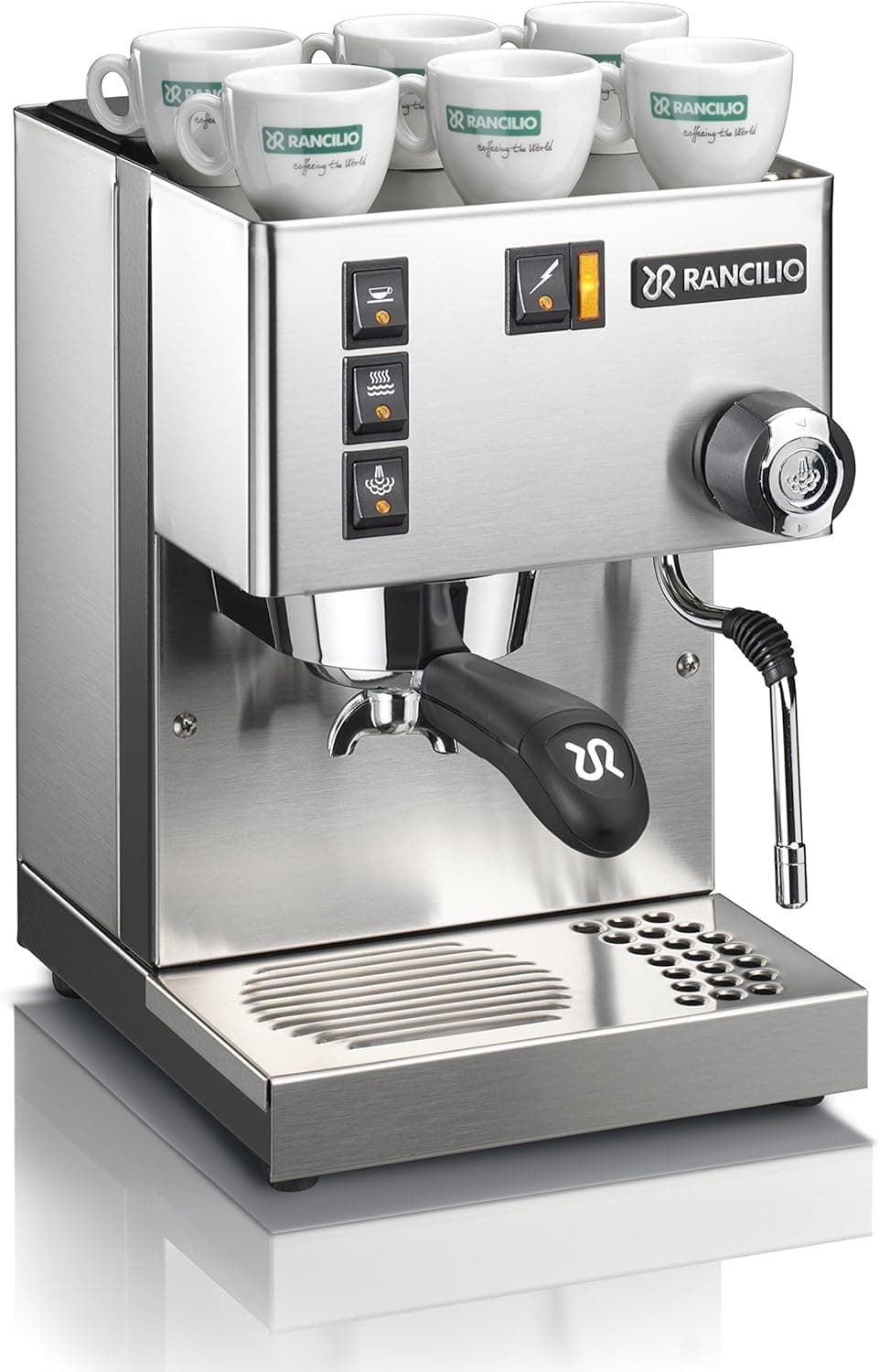
The build quality shows immediately: a stainless steel chassis and a real brass boiler, metal where competitors at this price use plastic.
The 58mm portafilter is chrome-plated brass and identical in diameter to Rancilio's professional café equipment, same thermal mass, same accessory compatibility as machines costing three times as much. It ships with two non-pressurized baskets: an 8-gram single and a 16-gram double, both proper commercial-style baskets rather than the pressurized training-wheel versions some machines hide behind.
Two things are conspicuously absent for a machine at this price. There's no pressure gauge on the front, and reviewers consistently flag the lack of included descaling instructions as a real gap, look up a guide before your first descale rather than expect one in the box.
The tamper deserves its own mention. Stainless steel with a blackwood handle, included in the box, an upgrade over the plastic tampers on earlier Silvia generations. Machines costing considerably more still ship plastic tampers. Rancilio didn't cut that corner. Owner reports of 15-plus year lifespans are common in enthusiast forums, and the parts and service ecosystem around this machine is enormous. Gaskets, group heads, steam wands, pumps, all of it is stocked and well documented.
The no-PID reality: temperature surfing
Here's the thing nobody explains clearly before you buy. The Silvia has one boiler and three non-adjustable thermostats, one each for brew, steam, and hot water. There's no digital control. The boiler just cycles on and off around a fixed mechanical set point, and that means the actual brew temperature swings depending on exactly when you pull the shot relative to that cycle. This is a genuine, well-documented characteristic of the machine, confirmed independently by outlets including Whole Latte Love, not a quirk limited to one bad unit.
To get consistent results, enthusiasts "surf" the temperature. Here's the routine in plain terms: run a short flush through the group head, which cools it slightly and triggers the heating element to kick back on. Wait for the temperature to climb back toward the right point, then lock in the portafilter and pull. Exactly how long that takes varies by kitchen and by how the machine has been run that morning, which is why most owners learn the timing by feel rather than a fixed number. Do it the same way every time and your shot temperature becomes repeatable, even without anything digital managing it.
You have two paths here. Learn to surf, it costs nothing, and with repetition it becomes routine rather than a ritual you dread. Or fit an aftermarket PID kit, which replaces the guesswork with a digital set point you dial in once. PID kits matter more for light roasts, where a few degrees of swing actually changes the cup.
Be honest with yourself about inconsistent shots on this machine. Far more often than not, it's heat-soak timing, puck prep, or the grinder, not the Silvia being temperamental. The machine is simple enough that there's nowhere for a mistake to hide.
How the espresso tastes
Once it's properly heat-soaked, independent reviews, including Tom's Guide, consistently describe the Silvia's espresso as classic and full-bodied, with real depth. This isn't a machine chasing café trends, it makes espresso the way espresso has tasted for decades, and that's exactly the point for the people who buy it.
It runs 9-bar extraction through non-pressurized baskets, which means the shot quality rises and falls with your technique. A good grind and a properly prepped puck reward you generously. A stale, uneven grind shows up in the cup immediately, there's no pressurized basket smoothing over your mistakes here.
Pair it with a decent burr grinder and put in the work on dose and distribution, and reviewers describe shots that compete with machines well above its price. That's the reward for the ritual, and it's a real one.
The steam wand
The steam wand is commercial-style, powerful, and moves through a wide range of motion, properly articulating, not the stiff stub you get on entry-level machines. It's consistently praised across independent reviews as one of the strongest wands at this price.
The catch is structural, not a flaw: single boiler means you brew first, then switch the dial to steam. You can't do both simultaneously. Plan your milk drinks around that, pull your shot, then steam, rather than expecting them to overlap.
Purge the wand before steaming to clear condensation. With practice, genuinely good microfoam and latte art are both achievable here, not a stretch goal.
The catch: this isn't a beginner machine
No PID out of the box means surfing or a mod, full stop, that's not a footnote, it's a real adjustment for someone coming from an automatic machine. Heat-up is slow compared to thermocoil or thermoblock competitors; sources don't agree on one specific number, but plan for a real wait rather than a quick warm-up. The single boiler workflow means brewing and steaming never overlap. And it's priced well into enthusiast territory, not a casual purchase.
The Silvia demands forward planning. You don't just walk up and pull a shot the way you would on a super-automatic, you think about timing, heat-soak, and your dose before you even touch the portafilter.
If what you actually want is an easy life, built-in grinder, automated workflow, no ritual required, a Breville is the smarter buy. The Breville Barista Pro gets you a fast heat-up and a real grinder in one box. If you want the mod culture and the learning curve without spending as much, the Gaggia Classic Pro is the cheaper, equally mod-friendly alternative.
Modding the Silvia
The Silvia's simplicity is exactly what makes it one of the best modding platforms in the hobby. PID kits, pressure gauges, flow restrictors, even full Gaggiuino-style microcontroller conversions, the community has built an enormous ecosystem around this one machine.
Worth being clear about what a PID actually buys you: it doesn't make the espresso taste better on its own. It makes your results repeatable with far less ritual attached. The temperature surfing trick and a PID kit are solving the same problem from two different directions.
This upgrade path is a real part of the Silvia's appeal. You buy the base machine, learn it, and then decide for yourself which mod is worth your money. You grow into this machine rather than out of it, which is rare in an industry that usually pushes you toward the next model up within a year.
Who should buy the Rancilio Silvia?
Buy it if: you want to genuinely learn espresso, you value a machine built to last decades over one built to be replaced, you like the idea of surfing or eventually modding, and you're pairing it with a real grinder.
Skip it if: you want plug-and-play simplicity, a built-in grinder, PID precision straight out of the box, go look at the Silvia Pro X, or you need to brew and steam milk back-to-back without planning around a single boiler.
Does the Rancilio Silvia have a PID?
No, not out of the box, and the Rancilio Silvia PID question comes up constantly precisely because the omission is one of the most-discussed things about this machine. The standard Silvia uses three non-adjustable mechanical thermostats for brew, steam, and hot water, which means boiler temperature swings naturally around a fixed set point. Owners manage this either by learning to temperature surf, a short flush followed by a wait before pulling, or by installing an aftermarket PID kit, which gives you a digital set point instead. If you want a PID built in from the factory, the Rancilio Silvia Pro X has one standard, along with a dual boiler and a shot timer.
What's the difference between the Rancilio Silvia and Silvia Pro X?
The standard Silvia is a single-boiler, no-PID machine with a vibration pump, mechanical, simple, and largely unchanged in design for two decades. The Silvia Pro X is the modernized version: dual boiler so you can brew and steam simultaneously, a built-in PID with a display and shot timer, and an auto-flush cycle on startup. It costs considerably more. The Pro X is the right choice if you want precision and simultaneous brew and steam without modding anything; the standard Silvia is the right choice if you want the classic mechanical experience and don't mind the ritual.
What size portafilter does the Rancilio Silvia use?
58mm, the full commercial standard, identical to what Rancilio uses on its professional café equipment. It ships with two non-pressurized baskets, an 8-gram single and a 16-gram double. Because 58mm is the most common commercial diameter, the aftermarket ecosystem is enormous: tampers, bottomless portafilters, precision baskets, and distribution tools from every major accessory maker fit without modification.
Is the Rancilio Silvia good for beginners?
Not as a first machine, honestly. There's no PID, no guided workflow, and a real learning curve around temperature surfing and puck prep before you get consistent shots. It's a machine that rewards dedicated learners rather than people who want results on day one. If you're new to espresso and want something more forgiving, look at a guided machine like the Breville Barista Pro. If you're committed to learning real espresso technique and don't mind the ritual, the Silvia is one of the best teaching machines available, you just have to want to learn.