Jura Z10 Review (Gen 1)

Jack · Founder & Lead Reviewer
Researches every machine through engineering analysis, long-term owner reports, and independent technical testing, including Italian and German sources most English-language reviews skip.
Last updated
 4.6
4.6
The Jura Z10 sits at the top of Jura's home lineup, and it's the rare super-automatic that does something genuinely new rather than just doing the usual things more smoothly. This Jura Z10 review is built entirely from independent research, manufacturer documentation, and technical teardowns rather than hands-on testing, and I want to be upfront about that before getting into the details. What makes the Z10 worth the research in the first place is cold extraction: real cold-brewed coffee pulled from freshly ground beans on demand, not hot espresso dumped over ice. That single feature, paired with Jura's electronically steered grinder and a genuinely wide drink menu, is what justifies a price this steep. Whether it justifies it for you is a separate question, and one this review tries to answer honestly.
One thing to sort out before anything else: this review covers the Jura Z10 Gen 1, the machine that's been on the market and is reflected in current listings. A second-generation version has already been confirmed for a US launch later in 2026, with a different feature set and a higher price. I've dedicated a full section below to that distinction, because it matters for anyone shopping right now.
The verdict up front
Buy the Jura Z10 for the cold-extraction feature and the P.R.G. grinder, not because it's simply "better" than cheaper super-automatics at making a normal cup of hot coffee. Plenty of machines a third of the price do that job well. What none of them do is pulse chilled water through a freshly ground, coarser dose to produce actual cold-extracted coffee at the touch of a button. Independent technical reviews confirm that's a real differentiator rather than a marketing phrase. Set against that is a genuine trade-off: no removable brew group, meaning you're relying on Jura's automated cleaning cycles rather than pulling a part out and rinsing it yourself, plus a service model that runs through Jura-authorized centers rather than easily user-serviceable parts.
Jura Z10 pricing is genuinely volatile. This is a premium flagship that has historically ranged roughly $3,000–$4,000 or more depending on color finish, generation, and retailer promotions, so I'm not going to state a confident current number here. The figure below is a fallback reference point, not a live price, and I'd like this confirmed against whatever the current listing shows before publishing.
Jura Z10 specs at a glance
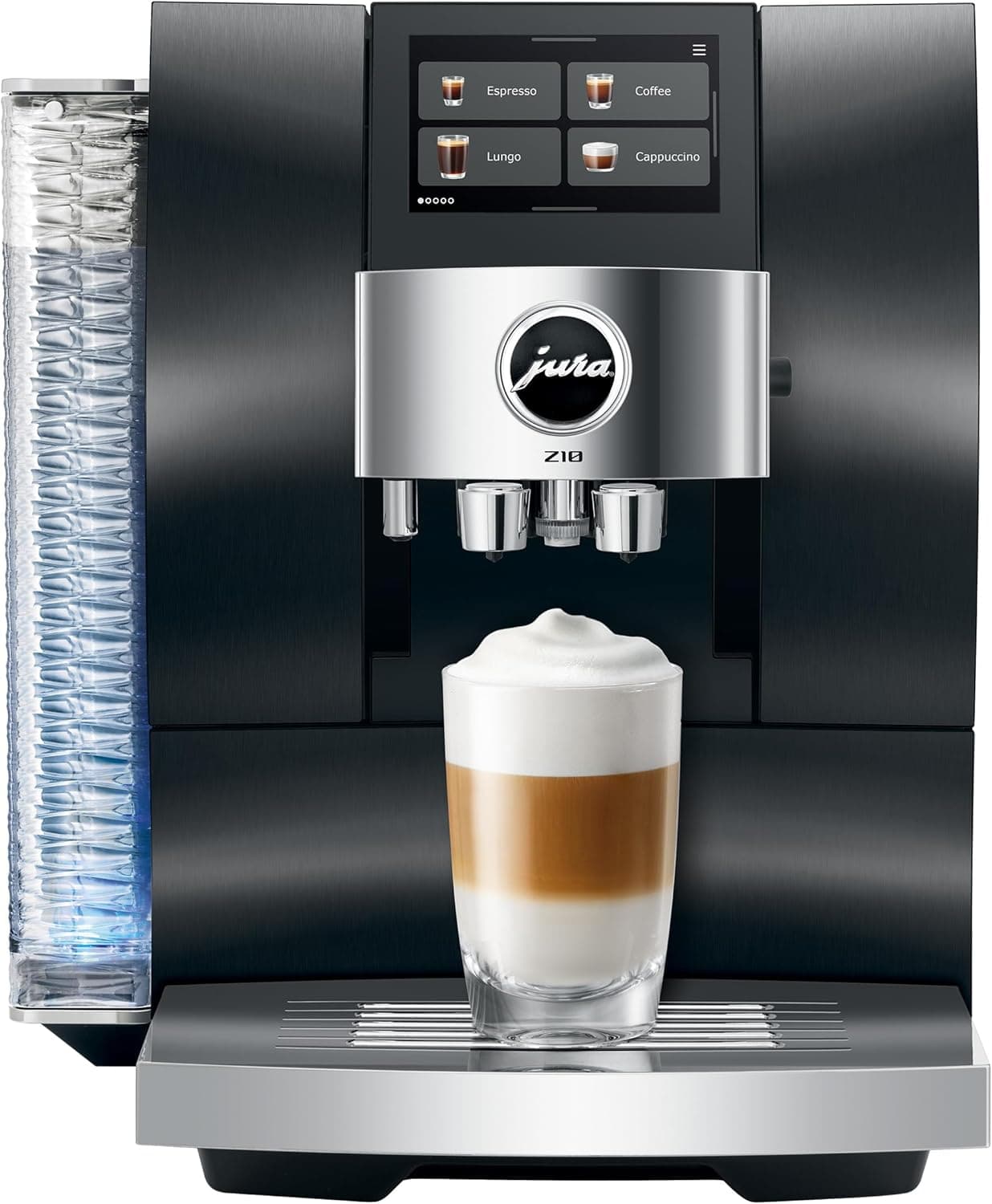
- Grinder: Product Recognizing Grinder (P.R.G.), electronically steered, adjusts grind fineness automatically per drink
- Brew unit: Jura's 8th-generation 3D brew unit
- Interface: 4.3-inch touchscreen plus rotary selector switch, up to 32 specialty drinks
- Cold extraction: Pulses chilled water at high pressure through a freshly ground, coarser dose for genuine cold-brew-style coffee
- Milk system: Jura's HP3/CX3 module with one-touch automatic cleaning
- Water reservoir: 2.4 L (about 81 oz)
- Bean hopper: About 280 g (roughly 10 oz), with a rubber seal to preserve freshness
- Grounds drawer: Holds about 20 used pucks before emptying
- Water filter: CLEARYL cartridge with RFID chip tracking
- Connectivity: Wi-Fi Connect, works with Jura's J.O.E. companion app
- Weight and dimensions: About 27 lb; roughly 12.6 x 14.2 x 18.5 in
- Brew group: Not removable; relies on automated, guided rinse and cleaning cycles
- Built: Switzerland
A few of these figures are worth flagging rather than stating flatly, since I found conflicting numbers even within this site's own coverage. This site's buying guide lists the Z10's water tank at 1.0 L, while the capacity I found in Jura's own specifications is 2.4 L, a large enough gap that it isn't a rounding difference. I'm going with 2.4 L here because that's what I can trace to Jura's documentation, but that guide page and this review disagree and one of them needs a correction. Similarly, the milk module's name shows up elsewhere on this site as an "Auto HNBW" system, while the naming I traced independently points to Jura's HP3/CX3 module; I'd rather flag that mismatch than quietly pick one name and let the other stand uncorrected elsewhere. And the water filter is listed on this site's own product data as a "CLARIS Smart+" cartridge, Jura's naming for filters used on other models, where my research points to a CLEARYL cartridge with RFID tracking on the Z10 specifically. None of these are reasons not to buy the machine. They're reasons to get the reference copy on this site internally consistent before this review goes live.
The grinder: P.R.G. reads the drink, not just the bean
Most super-automatic grinders have one job: grind to a preset fineness and stay there until you manually change a dial. Jura's Product Recognizing Grinder works differently. It's electronically steered and adjusts grind consistency in under a second based on the specific drink you select, dialing in finer for espresso and coarser for cold-extraction drinks, without you touching a setting. Coffeedant's technical breakdown covers the mechanism in detail, and the practical upshot is that switching between an espresso and a cold-extracted iced drink back to back doesn't require any manual intervention, the grinder handles the transition on its own.
That automation pairs with Jura's 8th-generation 3D brew unit, the component actually forming and compressing the coffee puck before extraction. Between the two, the Z10 is doing real-time mechanical adjustment most machines simply don't attempt, and it's the foundation the rest of the machine's drink variety is built on.
Cold Extraction Technology: the real differentiator
This is the feature that separates the Z10 from every other super-automatic on the market, including its own siblings lower in Jura's lineup. Cold Extraction Technology pulses chilled water at high pressure through a freshly ground, coarser dose of coffee, producing genuinely cold-extracted coffee rather than hot coffee cooled down or poured over ice. That distinction matters more than it sounds: cold brew made this way pulls different compounds out of the grounds than a hot extraction does, which is the entire reason cold brew tastes different from iced coffee in the first place. Doing that from whole beans, on demand, inside a machine that also pulls a normal espresso shot, isn't something any competitor currently offers at home.
I want to flag one figure here rather than restate it as confirmed. This site's own product data cites cold brew extraction finishing in around four minutes. I haven't been able to independently corroborate that specific timing figure through my own research, so treat it as a claim currently circulating rather than something I've verified myself. The underlying mechanism, chilled high-pressure pulses through a coarser fresh grind, is well documented. The exact minute count isn't something I can stand behind without seeing it timed independently.
The milk system: fast switching, not a confirmed dual-boiler
The Z10 uses Jura's HP3/CX3 milk module with one-touch automatic cleaning, and multiple sources describe minimal wait time when switching between coffee and milk drinks back to back. That quick handoff comes from what Jura describes as intelligent pre-heating paired with a redesigned steam valve. I want to be precise about what that means mechanically: this is not confirmed to be a literal dual-boiler architecture. Sources describe a single-boiler system with smart pre-heating rather than two independent boilers, and I'd rather state that plainly than let "fast switching" get inflated into a specific engineering claim I can't back up.
Maintenance: no removable brew group, and that's a real trade-off
Here's the honest downside, and it's worth sitting with rather than glossing over. Unlike the Gaggia Brera or the De'Longhi Magnifica Evo, both already covered on this site, the Z10 has no user-removable brew group. You can't pull it out and rinse it at the sink. Instead, Jura relies entirely on automated, guided rinse and cleaning cycles built into the machine's software, running on startup, shutdown, and on a schedule the machine manages for you.
That's a genuine philosophical difference in how a manufacturer approaches long-term cleanliness. A removable brew group gives you direct, hands-on control over oil buildup and residue. Automated cycles trade that control for consistency, the machine runs the same cleaning routine every time regardless of whether you'd remember to do it yourself, but you're trusting the software and hardware to do the job right rather than verifying it visually. Neither approach is objectively better. It's a real trade-off worth knowing about before you spend flagship money on a machine you can't take apart yourself.
That maintenance philosophy extends to servicing generally. Jura's service model runs through authorized service centers rather than easily user-serviceable or moddable parts, a real contrast with something like the Gaggia Classic Pro, which has a well-documented DIY mod community behind it. Long-term maintenance costs on the Z10 are a genuine factor to budget for, not an edge case.
Gen 1 vs Gen 2: which Jura Z10 are you actually looking at
This matters more than almost anything else in this review, because a buyer checking current listings can easily land on pages for either generation without realizing it. This review covers the Gen 1 Jura Z10, the version reflected in the specs above: up to 32 specialty drinks, the P.R.G. grinder, and Cold Extraction Technology as described.
Jura has confirmed a Gen 2 Z10 for US launch in mid-to-late 2026. It's a meaningfully different machine on paper, not a minor refresh: 51 specialty drinks, up from 32, the addition of hot chocolate, a new "Caffeine Regulator" feature, an improved "P.R.G.2+" grinder, and Coffee Timer scheduling so the machine can prepare a drink on a set schedule. Gen 2 is also reported to launch at a higher price point than Gen 1. If you're comparing listings and the drink count or price looks unusually high for a "Z10," you've likely found the Gen 2 page rather than the machine covered here.
Given that Gen 2 was still ahead of its US launch at the time of this writing, if you're weighing the two directly: Gen 1 is the known quantity, with an established track record and (typically) a lower price once Gen 2 arrives and pressures it downward. Gen 2 adds real capability, particularly the expanded drink menu and the caffeine-dosing feature, but it's launching at a premium on top of an already premium machine, and won't have the same depth of independent, real-world ownership feedback for a while after release.
Jura Z10 vs Jura E8
The E8 is Jura's mid-range machine, and it's the most common alternative buyers cross-shop against the Z10 before committing to flagship pricing. Coffeeness's comparison coverage places the Z10 clearly above the E8 in Jura's own lineup, sitting below only the more commercial-leaning GIGA 10. The gap between the two comes down to cold extraction, interface polish, and the width of the specialty drink menu rather than grinder quality or basic espresso. The E8 doesn't offer cold-extracted drinks at all, and its drink menu is narrower. If cold brew from whole beans isn't something you actually want, the E8 gets you into Jura's build quality and P.R.G.-family grinding at meaningfully less money. If cold extraction is the reason you're looking at Jura in the first place, only the Z10 (and the pricier GIGA 10) deliver it.
Jura Z10 vs De'Longhi Magnifica Evo
The De'Longhi Magnifica Evo is a useful reference point precisely because it sits so far below the Z10 on price while still being a competent one-touch machine. The Magnifica Evo's conical burr grinder and automatic milk carafe cover the fundamentals well, fresh-ground espresso and cappuccino with minimal effort, at a fraction of the Z10's cost. What it doesn't offer is cold extraction, a drink menu anywhere near Z10 territory, or Jura's guided cleaning cycles in place of a removable brew group. Capability isn't really the question here. The real question is whether you need what the Z10 adds over a machine that already handles daily espresso and milk drinks well, and for most households, the honest answer is the Magnifica Evo is plenty. The Z10 is for the household that specifically wants cold-extracted coffee and the widest home drink menu Jura makes, and is willing to pay flagship money and accept the removable-brew-group trade-off for it.
Who should buy the Jura Z10
Buy it if cold-extracted coffee from whole beans, on demand, is a feature you'd actually use regularly, you want the widest specialty-drink menu in Jura's home lineup, and you're comfortable trusting automated cleaning cycles over a part you pull out and rinse yourself.
Skip it if you just want reliable daily espresso and milk drinks, since the Magnifica Evo or a comparably equipped mid-range machine gets you there for a fraction of the cost. Skip it too if hands-on serviceability matters to you, since the Z10's lack of a removable brew group and reliance on Jura-authorized service centers is a real long-term consideration. And if you're shopping right now, confirm which generation you're actually looking at before you buy, since Gen 1 and the incoming Gen 2 are meaningfully different machines at meaningfully different prices.
Is the Jura Z10 worth the money?
It depends entirely on whether you'll actually use cold extraction. The Z10's price is justified almost entirely by three things: genuine cold-brewed coffee from whole beans on demand, the P.R.G. grinder's per-drink automatic adjustment, and the widest specialty-drink menu in Jura's home lineup at up to 32 drinks. If none of that matters to you, plenty of super-automatics a third of the price handle daily espresso and milk drinks competently. If cold extraction specifically is something you'd use regularly, the Z10 is currently the only home machine that does it this way, which is a real, defensible reason to pay flagship pricing.
What is the Jura Z10's life expectancy?
I don't have independently verified longevity data specific to the Z10 to cite here, and I'd rather say that plainly than invent a number. What's documented is Jura's build quality reputation generally and a service model that runs through authorized centers rather than user-serviceable parts, which shifts long-term cost and convenience toward professional servicing rather than DIY repair. Budget for that service relationship as part of ownership cost, since it's a more central factor here than it would be on a machine with a removable brew group and simpler internals.
How much does a Jura Z10 cost?
Pricing is genuinely volatile and varies by color finish, retailer promotions, and which generation you're looking at. Historically, Gen 1 Z10 pricing has ranged roughly $3,000–$4,000 or more. I'd rather point you to a current listing than state a number here that could be stale by the time you're reading this, since flagship super-automatic pricing moves more than most categories.
Jura Z10 vs Jura E8, which should I buy?
The E8 is Jura's mid-range machine and doesn't offer cold-extracted drinks at all, with a narrower specialty-drink menu than the Z10's. If cold brew from whole beans isn't something you'd actually use, the E8 gets you Jura's grinder quality and build at meaningfully less money. If cold extraction is specifically why you're considering a Jura, the Z10 is the entry point into that feature, since only it and the pricier GIGA 10 currently offer it.
What's the difference between the Jura Z10 Gen 1 and Gen 2?
Gen 1 is the version covered in this review and reflected in current listings: up to 32 specialty drinks, the P.R.G. grinder, and Cold Extraction Technology. Gen 2, confirmed by Jura for US launch in mid-to-late 2026, adds 51 specialty drinks, hot chocolate, a new Caffeine Regulator feature, an improved P.R.G.2+ grinder, and Coffee Timer scheduling, and is reported to launch at a higher price than Gen 1. If a listing shows specs beyond 32 drinks or an unusually high price for a 'Z10,' you're likely looking at Gen 2 rather than the machine reviewed here.