
Gaggia Brera Review (RI9305/11)

Jack · Founder & Lead Reviewer
Researches every machine through engineering analysis, long-term owner reports, and independent technical testing, including Italian and German sources most English-language reviews skip.
Last updated
 4.2
4.2
The Gaggia Brera has been on the market long enough to build a real track record, and that record is genuinely split. Owners either land on a machine they run daily for years, or one that starts throwing errors and shedding parts within the warranty period. This Gaggia Brera review is built from independent testing, technical teardowns, and owner reports rather than hands-on time with the machine myself, and I'm laying out both sides rather than smoothing over the parts that don't flatter it. The short version: a ceramic grinder and a fully removable brew group that punch above the price, sitting next to a documented pattern of reliability complaints that's hard to wave away.
The verdict up front
Buy the Gaggia Brera espresso machine for the grinder and the maintenance story, not for peace of mind about longevity. The removable brew group and cool-running ceramic burrs are real advantages at this price. The flip side, confirmed across multiple independent sources, is a build that leans heavily on plastic and a meaningful share of owners reporting grinder and pressure problems over time. Go in with both facts in hand.
Gaggia Brera pricing has moved around a fair amount over the years, and independent price histories put it well under $600, with discounts frequently landing it in the $350–450 range depending on retailer and timing. I'm using $399 as a reasonable reference point below rather than a fixed number, since I haven't independently verified where it's sitting today.
Gaggia Brera specs at a glance
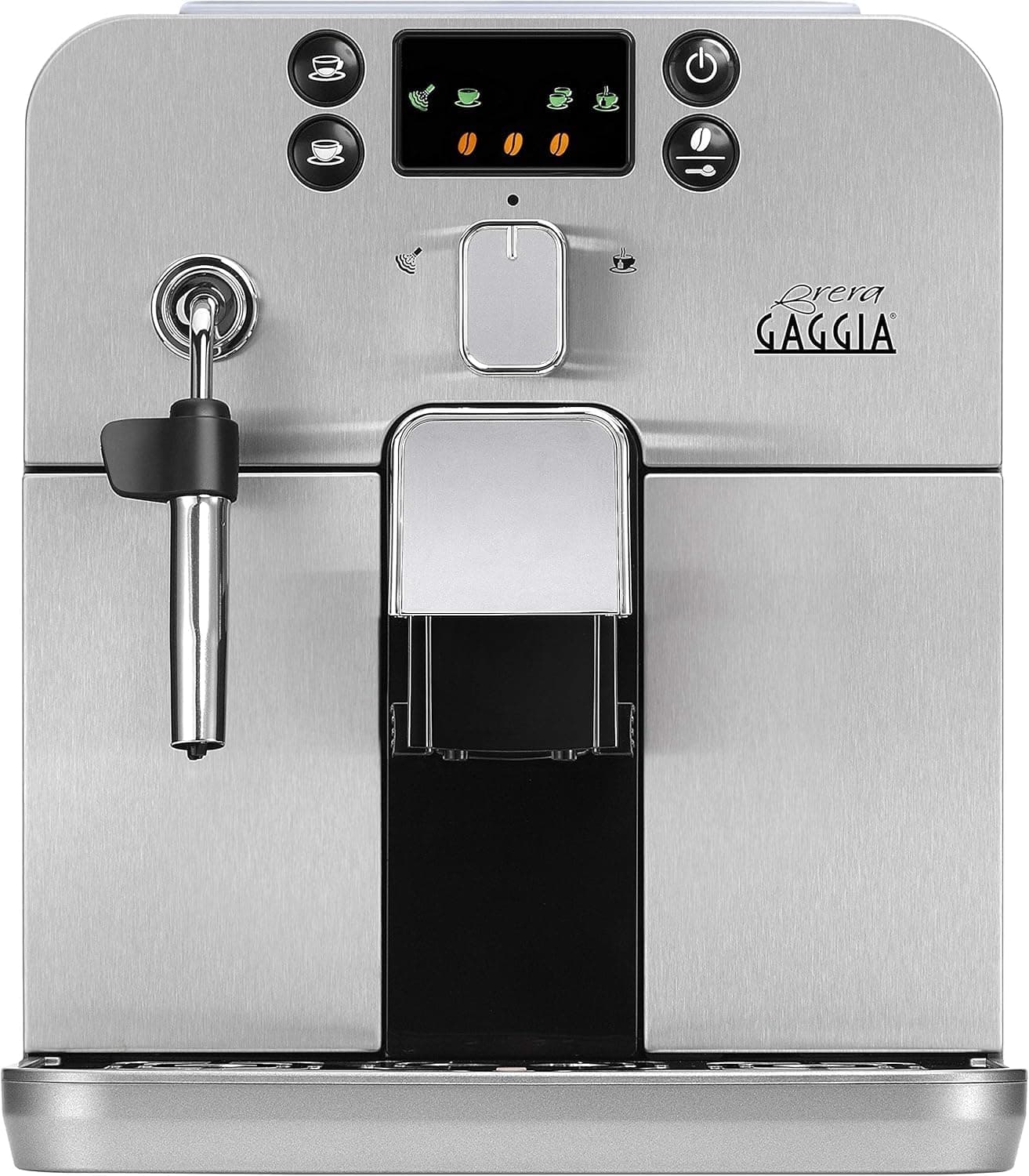
- Grinder: Ceramic flat burr, 5 grind settings, with Gaggia's Adapting System
- Bean hopper: Roughly 8 oz (226 g), airtight
- Water reservoir: 1.2 L, needs frequent refilling for regular daily use
- Pump: 15-bar Ulka pump
- Heating: Stainless steel thermoblock with integrated PID control
- Milk system: Manual stainless steel Pannarello wand
- Pre-ground: Bypass doser accepts pre-ground coffee alongside whole bean
- Brew group: Fully removable, rinses at the sink
- Weight: Around 18 lb
- Warranty: 1 year
One dimension I'm intentionally not restating here: published specs for the Brera's width vary between sources I checked, including against figures already used elsewhere on this site, and I'd rather flag that than print a number I can't stand behind. Depth and height are consistent across sources at roughly 12.4 in H x 17 in D. What every source agrees on is that this is a compact machine built to fit tighter kitchen footprints than most super-automatics in its class.
The grinder: ceramic burrs, five settings, an "Adapting System"
The Brera's built-in grinder uses ceramic flat burrs rather than the steel burrs common at this price. Ceramic runs cooler during grinding, since it transfers less heat into the beans than steel does, which helps preserve aroma compounds that heat can degrade. Ceramic also holds its edge longer than steel over the life of the machine. The trade-off is brittleness: ceramic burrs are more vulnerable to damage from a stray stone or hard foreign object in the hopper than steel burrs would be, so keeping the hopper clean matters more here than it does on a steel-burr machine.
Five grind settings is workable but genuinely limited next to competitors. Coffeeness's review puts this in context directly, noting that rival machines in the same bracket offer 12 to 13 settings, and that experienced home baristas are the ones most likely to feel boxed in by the Brera's narrower range.
Gaggia calls the automated dosing feature the "Adapting System," and the idea is that the machine adjusts grind time and dose over the first several shots on a new bag of beans, gradually normalizing output to that bean's density and roast level. In practice, Coffeeness's testing found the manual grind adjustment had surprisingly little effect on the shot compared to what you'd expect from a dedicated grinder, worth knowing if you were hoping to fine-tune extraction the way you would on a standalone burr grinder. The bypass doser is a genuine plus here: it lets you skip the grinder entirely and brew pre-ground coffee, useful for decaf or a specialty bag you don't want to run through ceramic burrs at all.
Espresso and how it's actually brewed
Under the hood, the Brera runs a 15-bar Ulka pump and a stainless steel thermoblock with integrated PID control, per Coffeedant's technical review, which measured brewing temperature reached in under 60 seconds from a cold start and consistency within about ±2°F across consecutive shots. That's a genuinely tight tolerance for a thermoblock system, though Coffeedant also notes the minimal thermal mass means external factors, room temperature and the water going in, have a real effect on how the cup lands.
Pre-infusion is standard here too: the machine wets the puck at a lower pressure, in the 3 to 4 bar range per Coffeedant's measurements, before ramping to full extraction pressure. That's a feature more commonly reserved for pricier machines, and its presence on the Brera is a genuine point in its favor. Real extraction pressure at the puck lands closer to 9 bar once system resistance is accounted for, typical for a pump-driven machine regardless of what the pump itself is rated at.
The milk system: Pannarello, not precision microfoam
The Brera uses a manual stainless steel Pannarello wand rather than an automatic carafe. That means you're steaming milk by hand, angling the pitcher and controlling texture yourself, which is either an upside or a downside depending on what you want. It's genuinely easy to use and produces a simple, frothy milk texture quickly, well suited to cappuccino-style foam.
What it doesn't deliver is precision microfoam. If you're chasing latte art or a specific fine-textured pour, the Pannarello's single-hole design caps how much control you have compared to a proper steam wand or an automatic system tuned for consistency. Coffeeness's hands-on notes also flag the wand itself as feeling less durable than its stainless finish suggests, a fair caution given how much daily use a steam wand takes on in an espresso-first household.
Maintenance: the brew group is the real strength
This is where the Brera earns real credit. The brew group is fully removable, no tools required, and rinses clean under the tap. That's a meaningful maintenance advantage over machines where the brewing internals are sealed inside the housing and slowly accumulate oil residue that you can't reach. Multiple independent reviewers single this out as a genuine strength, not a marketing checkbox.
The 1.2 L water tank is the other side of the daily-use ledger. It's small, and for a household making more than a couple of drinks a day, expect to refill it often. That's a known trade-off of the Brera's compact footprint, not a defect, but it's worth planning around if you're buying for more than one person.
The honest reliability discussion
This is the part of the Gaggia Brera story that's easy to gloss over, and I'd rather lay it out plainly. Independent sources describe a real, multi-sourced pattern of owner complaints, not an isolated handful of one-star outliers.
Coffeedant's review cites a customer rating breakdown of roughly 38% five-star against 29% one-star, an unusually polarized split that points to genuine inconsistency in the ownership experience rather than a machine that's simply mediocre across the board. The most frequently documented failure, per that same review, is a false "no beans" error that triggers even with a full hopper, generally traced to oil buildup, worn sensors, or calibration drift over time. Beyond that specific error, owners report grinder failures and inconsistent brewing pressure developing after months of use, plus plastic components breaking within the warranty window.
Build quality is the throughline connecting most of these complaints. Despite marketing language describing a stainless steel build, a magnet test in Coffeedant's review found that only the drip tray grate actually contains metal; the front panels, side housing, and other structural components are plastic with a metallic-look finish. Coffeeness's independent testing reached a similar conclusion on its own, describing a lingering sense that "something will end up breaking sooner rather than later" despite reasonable day-to-day performance.
None of this means every Brera fails. It means the odds of hitting a frustrating issue, particularly around the grinder or the plastic build, are higher than you'd want at this price, and that risk is worth weighing against the genuine strengths above rather than ignoring in either direction.
Gaggia Brera vs De'Longhi Magnifica Evo
The De'Longhi Magnifica Evo is the closest one-touch comparison most Brera shoppers land on. The Magnifica Evo uses a stainless steel conical burr grinder with 13 settings, a wider range than the Brera's 5, and pairs it with a fully automatic milk carafe rather than a manual wand, meaning less hands-on effort for milk drinks. What the Brera answers back with is the ceramic grinder's cooler running temperature and, more importantly, a brew group you can actually pull out and rinse, something the Magnifica Evo's sealed one-touch design doesn't offer in the same way. If automated milk and a wider grind range matter more to you than hands-on brew group maintenance, the Magnifica Evo is the safer pick. If you want a manual wand and don't mind steaming your own milk, the Brera's grinder and cleaning story make a real case.
Gaggia Brera vs Philips 3200 LatteGo
The Philips 3200 LatteGo is the other machine the Brera regularly gets cross-shopped against, and the two are closer in spirit than the Magnifica Evo comparison. Both use ceramic grinders, both are compact by super-automatic standards, and both sit in a similar price bracket. The Philips pulls ahead on cleanup, with the tube-free LatteGo carafe against the Brera's manual Pannarello wand, and it also spreads its independent reliability record across a review base that doesn't flag the same kind of documented plastic-build and grinder complaints found on the Brera. Where the Brera answers back is the fully removable brew group, a maintenance advantage the Philips doesn't match, plus the bypass doser for pre-ground coffee, a feature the 3200 skips.
Who should buy the Gaggia Brera?
Buy it if you want a compact super-automatic with a genuinely serviceable brew group, you value the ceramic grinder's cooler running temperature over a wide grind range, and you're comfortable with the tradeoffs of a manual steam wand and a small water tank in exchange for the price.
Skip it if long-term reliability with minimal fuss is your top priority, since the documented pattern of grinder and build complaints is real and worth weighing seriously. If you want the widest possible grind range or hands-off automatic milk, the De'Longhi Magnifica Evo is worth pricing out instead, and if cleanup and a stronger reliability record matter most, the Philips 3200 LatteGo is the closer comparison.
Is the Gaggia Brera a good espresso machine?
It's a genuinely mixed picture, and that's the honest answer. The Gaggia Brera's ceramic grinder and fully removable brew group are real strengths that independent reviewers consistently praise, and the thermoblock's PID control plus pre-infusion are features you don't usually see at this price. Set against that, multiple independent sources document a real pattern of owner complaints, grinder issues, inconsistent brewing pressure over time, and a build that's mostly plastic despite stainless steel marketing language. Whether it's 'good' for you depends on how much weight you put on the maintenance and grinder story versus the documented reliability risk.
What are common problems with the Gaggia Brera?
The most frequently documented issue is a false 'no beans' error that triggers even with a full hopper, usually traced to oil buildup, worn sensors, or calibration drift, and the usual workaround is a light shake of the machine to resettle the beans and reset the sensor. Beyond that specific quirk, independent sources report grinder failures and inconsistent brewing pressure developing after extended use, along with plastic components that some owners report breaking within the warranty period. A magnet test found the machine's 'stainless steel' panels are largely plastic with a metallic finish, which is worth knowing going in.
Gaggia Brera vs De'Longhi, which is better?
It depends which De'Longhi you're comparing it to, but against the closest match, the De'Longhi Magnifica Evo, the two split on different strengths. The Magnifica Evo's conical burr grinder offers a wider 13-setting range and pairs with a fully automatic milk carafe, less manual effort for milk drinks. The Brera counters with a ceramic grinder that runs cooler and a brew group you can pull out and rinse at the sink, a maintenance advantage the Magnifica Evo's sealed design doesn't match. If automated milk and grind range matter more, the Magnifica Evo is the safer choice. If hands-on brew group cleaning and a manual wand work for your routine, the Brera holds its own.
How many grind settings does the Gaggia Brera have?
Five. That's workable for finding a reasonable extraction on most medium roasts, but it's narrow next to competitors in the same price bracket that offer 12 to 13 settings, and independent reviewers note that experienced home baristas are the ones most likely to feel limited by the range. The ceramic burrs also run through Gaggia's Adapting System, which auto-adjusts grind time and dose over the first several shots on a new bag, though independent testing found manual grind adjustments have a smaller effect on the final shot than you'd expect from a dedicated grinder.