De'Longhi Dinamica Plus Review

Jack · Founder & Lead Reviewer
Researches every machine through engineering analysis, long-term owner reports, and independent technical testing, including Italian and German sources most English-language reviews skip.
Last updated
 4.4
4.4
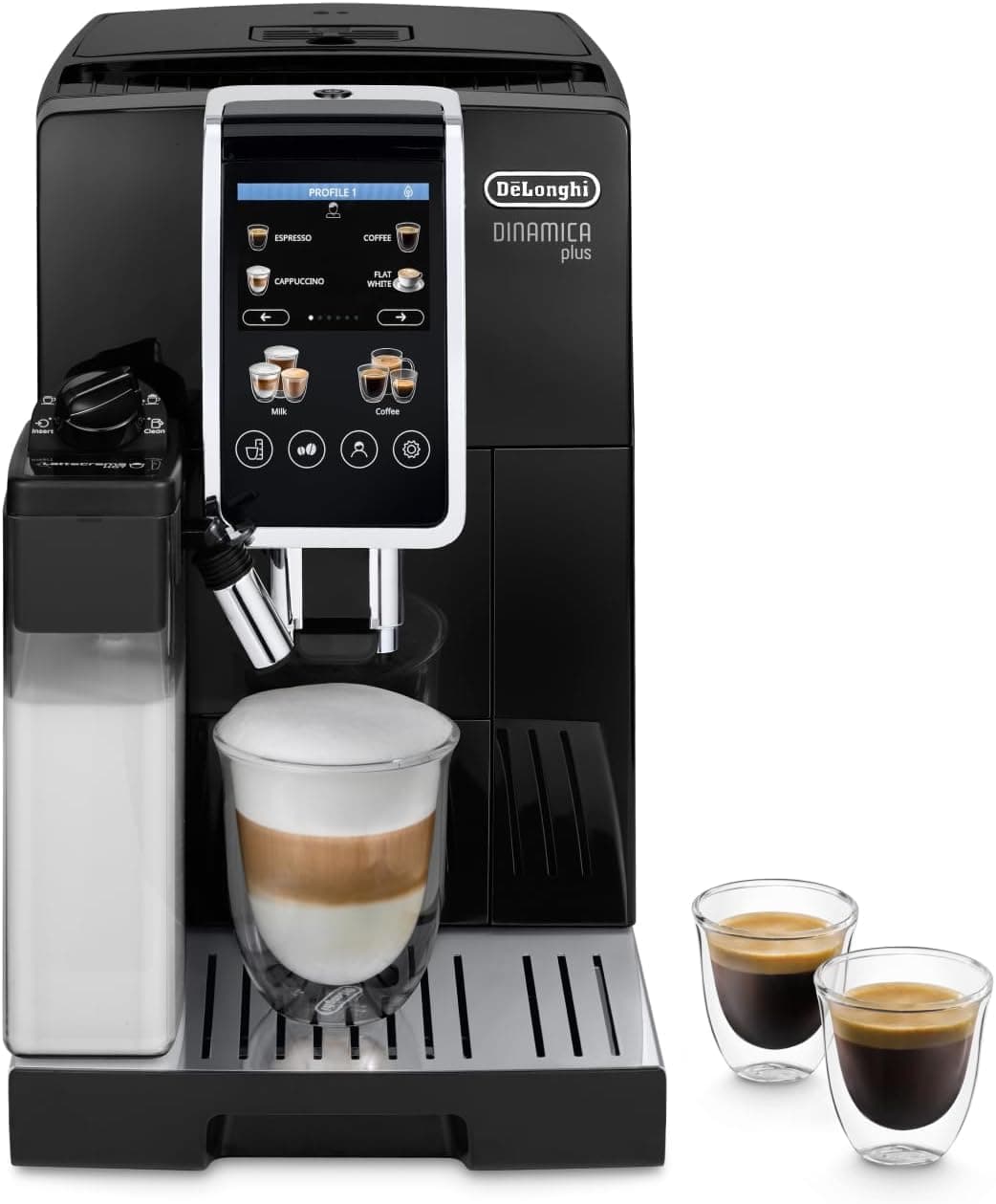
The De'Longhi Dinamica Plus is the machine people land on when the Magnifica Evo feels a step too basic and a Jura feels like too much money. It sits in the middle of De'Longhi's bean-to-cup range with a color touchscreen, an app, and the LatteCrema automatic milk carafe. I haven't run this one on my own counter. This De'Longhi Dinamica Plus review is built from De'Longhi's own documentation, independent hands-on reviews, retailer spec sheets, and owner reports, and I'll say plainly where those sources disagree rather than smooth it over. One question comes up more than any other from people shopping this machine, so it gets its own section below: what actually changes when you move from the standard Dinamica to the Dinamica Plus.
The verdict up front
Buy the Dinamica Plus for the interface and the milk automation, not because it pulls a better shot than cheaper De'Longhi machines. The brewing hardware here, the conical burr grinder and the 15-bar pump, is the same setup you get further down the range. What the extra money buys is a color touchscreen in place of buttons, the Coffee Link app, a set of cold and iced recipes, and the LatteCrema carafe that froths milk without you touching a wand. If those things match how you'd use the machine every morning, it earns the premium. If you mostly drink straight espresso, the value case gets thin fast.
De'Longhi's list price on the Dinamica Plus has sat near $1,499, and the street prices I found while researching ranged from roughly $1,100 to $1,300, with occasional sales lower. I haven't independently confirmed where it's sitting today, so treat the figure below as a rough reference rather than a live quote, and I'd want it checked against the current listing before this runs.
De'Longhi Dinamica Plus specs at a glance
- Grinder: Integrated conical burr, 13 grind settings, adjusted with a dial inside the bean hopper
- Milk system: LatteCrema automatic carafe, 3 froth settings (light foam, creamy foam, dense foam), works with dairy and plant milk alternatives, removable and fridge-storable
- Drink menu: 16 one-touch recipes from the panel, including espresso, lungo, cappuccino, latte, macchiato, flat white, cortado, and cold and iced "To Go" recipes
- Interface: Color touchscreen, plus the De'Longhi Coffee Link app for remote control and recipe customization
- User profiles: 3 savable profiles for personalized drink settings
- Heating: De'Longhi "Dual Heating System" (see the section below on what that does and doesn't mean)
- Pump: 15-bar
- Water tank: About 60 oz
- Grounds container: About 10.5 oz capacity
- Power: 1250W, 120V/60Hz (US spec)
- Pre-ground: Bypass funnel included alongside whole-bean grinding
One number here needs a caveat. I've gone with 16 one-touch recipes because that's the figure the strongest independent sources and De'Longhi's retailer spec sheets consistently gave me for the panel menu. Other counts circulate: some Amazon listings say 18, some reviews cite 24, and this site's own product data implies 24 or more. That gap most likely comes from firmware updates that expanded the menu on later units, or from counting every customizable variation rather than the base one-touch list. I can't reconcile it from the outside, so I'm flagging it rather than picking a side.
The grinder
The Dinamica Plus grinds whole beans through an integrated conical burr unit with 13 settings, adjusted with a dial inside the bean hopper while the grinder runs. That's the same 13-step range De'Longhi puts on the Magnifica Evo and most of its bean-to-cup machines. Independent reviews from Coffeeness and Black Ink Coffee both confirm the count and describe the factory calibration as close enough that dialing in doesn't take long. Level 3 comes up in both as a sensible starting point.
Thirteen settings is fine for medium and medium-dark roasts, the range most people buying a super-automatic actually drink. Light roasts are where it runs short. The steps sit far enough apart that getting fine enough for a slow, even extraction from a bright washed coffee means settling for close rather than exact. If your beans are usually medium or darker, this won't come up much.
A bypass funnel sits next to the hopper for pre-ground coffee, which is the clean way to run a decaf or a guest's bag without flushing the grinder. Shots off pre-ground come out flatter than fresh, so it's a fallback, not a daily path.
The LatteCrema milk system
This is the reason most people pick the Dinamica Plus over something cheaper. In place of a manual steam wand, it ships with the LatteCrema carafe: a sealed jug that clips onto the front, pulls milk through an internal tube, and froths automatically when you select a milk drink. A knob on the lid sets one of three textures, light foam, creamy foam, or dense foam, so a flat white and a cappuccino come out with different milk rather than the same froth in a different cup.
It handles plant milk as well as dairy, though the result varies more with oat or almond than it does with whole milk, and you may go through a couple of barista-edition cartons before one froths the way you want. Coffeeness describes the foam as fine and consistent, sometimes firmer than ideal for a proper flat white, which tracks with how automatic systems tend to behave next to a trained hand on a wand.
The carafe comes off in one piece and goes straight into the fridge between drinks, so you're not pouring milk back and forth or leaving it on the counter. It still needs a rinse, and De'Longhi builds an automatic clean cycle into the milk path that runs after use.
The "Dual Heating System", and what it actually means
De'Longhi markets the Dinamica Plus with a "Dual Heating System," and the phrase is easy to read as two boilers running in parallel. Based on how the same language works on other De'Longhi machines I've looked at, including the ones behind my Magnifica Evo and Casabrews 5700 Pro coverage, that isn't what's happening. The Dinamica Plus brews through a single thermoblock. The "dual" part most likely points to a separate heating element on the milk side that keeps the frothing circuit ready, so the machine spends less time switching between pulling a shot and steaming milk.
The practical effect is a shorter wait when you go from espresso to a milk drink, which is worth something if you make back-to-back cappuccinos. It does not do true simultaneous brew-and-steam, the way a genuine dual-boiler machine like the Breville Oracle Touch does. If a listing or a video makes it sound like this machine brews and steams at the same time, that's the marketing outrunning the hardware. I'd treat the milk-side heater as a convenience that trims the handoff, not a boiler you can lean on for parallel work.
Dinamica vs Dinamica Plus
This is the comparison worth getting right, because the two machines look more different in marketing photos than they are under the housing.
The standard Dinamica and the Dinamica Plus share the same core brewing hardware. Same conical burr grinder, same 15-bar pump, same single boiler, same brew unit. The espresso that comes out of one is the espresso that comes out of the other. Nothing about the shot itself improves when you move up.
What the Plus adds is the layer around the coffee:
- A color touchscreen in place of the standard Dinamica's simpler button-and-display panel
- The De'Longhi Coffee Link app, for adjusting recipes and running maintenance prompts from your phone
- The cold and iced "To Go" recipe menu
- On most Plus variants, the LatteCrema automatic milk carafe instead of the standard model's manual steam wand
Put plainly: buying the Dinamica Plus means paying for the interface, the app, and milk automation. It does not mean buying a machine that makes better espresso. If you steam milk by hand happily and don't care about app control or a touchscreen, the standard Dinamica gets you the same cup for less. If one-touch milk drinks and iced recipes are the point, the Plus is the version that does them, and the Dinamica vs Dinamica Plus decision comes down to how much that automation is worth to you.
The app and user profiles
The Coffee Link app connects over Bluetooth, so it works when your phone is near the machine rather than from anywhere in the house. Within range it handles remote drink starts and custom recipe saving, and it surfaces reminders for descaling and cleaning. Black Ink Coffee singles out the maintenance guidance as the half of the app that stays useful past the first week, once the novelty of starting a coffee from your phone wears off.
The machine stores three user profiles, each holding its own set of drink preferences. Three covers a couple plus a guest setting. A larger household will run into people overwriting each other. Some owner reports also mention the app pairing being fussy on certain Android builds, so if app control is a big part of why you're buying, it's worth checking recent feedback for your phone.
How long it should last
De'Longhi's bean-to-cup machines in this class are commonly reported to run about 10 years with regular descaling and the cleaning the machine asks for. Take that as a general expectation, not a promise. Water is the variable that matters most: descale on schedule, use filtered water if your supply is hard, keep the milk circuit clean, and a machine like this tends to reward the attention. Skip the maintenance and the failure usually shows up in the brew unit or the milk system well before year ten.
Who should buy the De'Longhi Dinamica Plus
Buy it if you want one-touch milk drinks with a real automatic carafe, you like the idea of a touchscreen and app control, and cold or iced coffee is part of your routine. It's a good fit for a one or two person household that drinks cappuccinos and lattes daily and would rather not learn a steam wand.
Skip it if straight espresso is most of what you drink, since you'd be paying a premium for automation you won't use, and the cheaper standard Dinamica or the Magnifica Evo pull a comparable shot. Skip it too if light roasts dominate your shelf, because 13 grind settings will feel tight, or if you specifically need simultaneous brewing and steaming, which the single thermoblock here doesn't do regardless of the "Dual Heating" label.
What's the difference between the Dinamica and Dinamica Plus?
The two share the same brewing hardware: the same conical burr grinder, the same 15-bar pump, the same single boiler, and the same brew unit, so the espresso itself is the same. The Plus adds a color touchscreen in place of the standard model's button panel, the De'Longhi Coffee Link app, a cold and iced 'To Go' recipe menu, and, on most versions, the LatteCrema automatic milk carafe instead of a manual steam wand. Moving up gets you the interface, the app, and milk automation, not a better shot.
How many grind settings does the Dinamica Plus have?
Thirteen, set with a dial inside the bean hopper while the grinder is running. That range covers medium and medium-dark roasts comfortably. Light roasts are harder, since the finer settings sit close together and the ceiling is lower than a dedicated grinder's. It's the same 13-setting grinder De'Longhi uses across much of its bean-to-cup lineup, including the Magnifica Evo.
Does the Dinamica Plus have dual boilers?
No. De'Longhi markets it with a 'Dual Heating System,' but the brewing side runs on a single thermoblock. The 'dual' part points to a separate heater on the milk circuit that shortens the wait when you switch between coffee and steaming, not a second brew boiler. It can't brew espresso and steam milk at the same time the way a true dual-boiler machine can.
How long does a De'Longhi Dinamica Plus last?
De'Longhi bean-to-cup machines in this class are commonly reported to last around 10 years with regular descaling and maintenance. That's a general expectation rather than a guarantee, and it depends heavily on water hardness and whether you keep up with the cleaning cycles the machine prompts for. Neglected descaling is the usual reason one of these fails early, typically in the brew unit or the milk system.