
Breville Barista Express Review (2026)

Jack · Founder & Lead Reviewer
Researches every machine through engineering analysis, long-term owner reports, and independent technical testing, including Italian and German sources most English-language reviews skip.
Last updated
 4.8
4.8
The Barista Express is the machine that convinced a generation of home cooks that café-quality espresso was achievable without a separate grinder, a separate tamper ritual, and a counter full of gear. When it launched, an all-in-one machine with a real conical burr grinder was unusual. Today Breville sells three successors to it, and the original is still on the market at a real discount to all of them. This Breville Barista Express review is built from Breville's own specs, independent lab testing, and owner reports rather than hands-on time with the machine myself, and the question worth answering is whether the original holds up now that the newer versions cost more but offer more.
It does, with caveats. Two criticisms before the positives. The 16-setting grinder has coarser steps at the fine end than the Barista Express Impress (25 settings) or Barista Pro (30 settings), so dialing in a light roast means settling for close enough rather than landing precisely where you want. And the Thermocoil takes about 30 seconds to heat from cold by Breville's own spec, which sounds trivial until you factor in the dosing and tamping that happen before that first shot. I'd rather flag both up front than let the spec sheet oversell the machine.
The verdict up front
The Barista Express is still a strong buy for the buyer who wants a single machine that does everything and is willing to learn to tamp manually. It is not the right machine if auto-tamping matters, if you're chasing light roasts seriously, or if a fast heat-up is a genuine daily priority.
The pressure gauge is a teaching tool
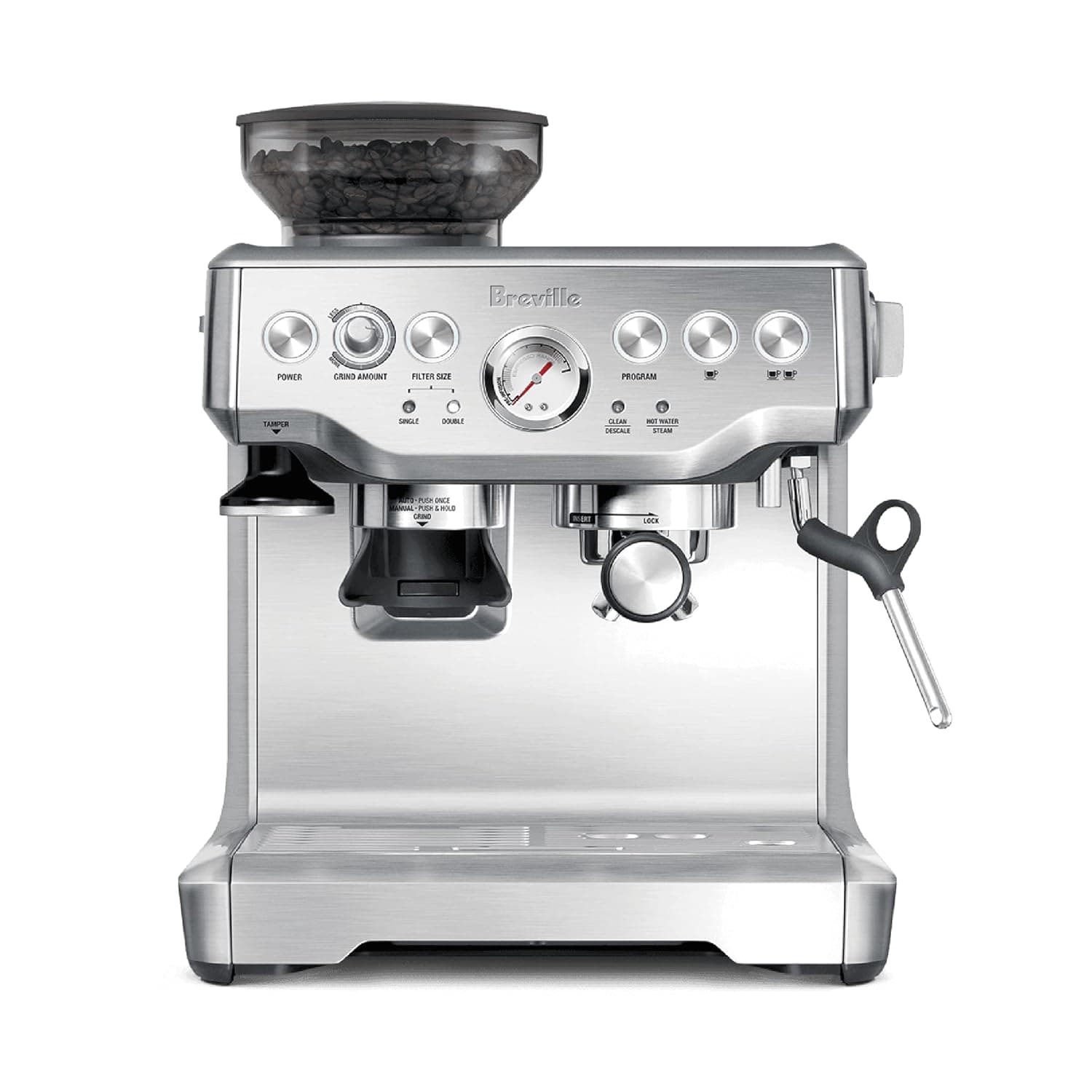
Every Breville Barista model has something on the front panel that gives extraction feedback. The Barista Pro and newer machines use an LCD showing temperature. The Barista Express uses an analog pressure gauge showing extraction pressure in real time. For a beginner, the pressure gauge is the better teacher.
Here's why. During a shot, the gauge needle moves into a marked zone for correct extraction. Too fine a grind and pressure builds too high; too coarse and it drops too low. Watching that happen in real time builds an intuition about extraction that a temperature readout doesn't give you as directly. That's a big part of why I'd point a first-time buyer toward the Express over something more automated.
The gauge reads relative, not absolute. It tells you whether pressure is in the right range, not the precise bar figure. That's enough for the purpose. The practical answer to "is this shot extracting correctly?" is visible at a glance.
Pre-infusion: the feature nobody mentions
Before the main extraction begins, the Barista Express runs a low-pressure pre-infusion for about three seconds. Water saturates the puck gradually before the full 9 bar kicks in. Whole Latte Love's review describes the effect simply: the low-pressure phase gently expands the grounds for a more even extraction. This matters more than it sounds.
Pre-infusion gives the coffee grounds time to swell and fill any dry channels or voids in the puck before pressure hits. Channeling (where pressurized water finds a weak point in the puck and drills through instead of percolating evenly) is the most common cause of sour, underextracted espresso. Pre-infusion doesn't eliminate it, but it meaningfully reduces it, especially on imperfect tamps.
For a beginner who's still developing tamping technique, this is a genuine aid. Shots are more forgiving than they would be from a machine that hits full pressure immediately. It also means the gap between a good tamp and a passable tamp is narrower in practice.
The grinder: good, with a known ceiling
The conical burr grinder doses directly into the portafilter. No separate dosing cup, no transfer step, minimal mess, which by design limits how much ground coffee can linger between sessions. It's about as friction-free as an integrated grinder gets.
Sixteen settings. This is the number that defines the machine's limitation. Settings 1–5 cover espresso range; settings 6–16 are for filter brewing you'll never use this machine for. Inside the espresso range, five steps means each step is a meaningful jump. On a medium or dark roast, you can find a setting that works and the extraction time lands in range. On a lighter roast that wants to live between two settings, you're choosing the lesser of two approximations.
For a medium or dark roast, that range is plenty. The complaint shows up on lighter roasts, where the ideal setting often sits between two clicks rather than on one of them, forcing a wider variance in shot time than a finer-stepped grinder would allow. That's the honest trade-off of a 16-setting dial.
The grinder does not produce a size-on-demand dose by weight. It doses by grind time, which is calibrated to a target amount. Beans vary in density, so your actual dose weight can drift a gram or two session to session. Use the Razor dose trimmer that ships with the machine to level the puck before tamping. It removes excess grounds and keeps dose consistency tighter than eyeballing.
Extraction and shot quality
Coffeedant's review puts a properly dialed-in shot from this machine within Specialty Coffee Association extraction standards, with a syrupy body and crema that holds for a meaningful stretch rather than collapsing right away. That lines up with the general reputation: once the grind is dialed in, this machine pulls a genuinely good shot. Nothing about the extraction hardware is cutting corners. It's the same 15-bar pump, regulated down to about 9 bar at the puck, the same Thermocoil, and the same 54mm basket as its pricier siblings.
The PID-controlled Thermocoil holds temperature consistently through back-to-back shots. Coffeedant's testing puts the variance at around 1°F during extraction, genuinely tight for this class of machine. That thermal stability matters for repeatability: once you dial in a setting, the machine holds it.
One honest note on milk: steam and brew are sequential on any single-boiler machine. Pull the shot, switch the dial to steam, wait for the wand to come up to steam temperature, then froth. For one cappuccino this is fine. For back-to-back drinks for two people it's noticeable. That's a single-boiler constraint the Express shares with every machine in its class.
Thermocoil heat-up: the daily trade-off
Cold start to brew-ready takes about 30 seconds on the Thermocoil, per Breville's own spec. If you wake up and immediately want espresso, you're waiting. If you turn the machine on while you grind (which you're doing at the machine anyway, so this applies to the first shot of the day from a pre-ground bag), you may not even notice the wait.
The practical sequence is straightforward: flip the machine on, fill the portafilter, let it come to temperature, then pull. A ready light illuminates when the Thermocoil is up to temperature. That 30-second figure covers the boiler alone. Dosing and tamping happen on top of it, so the real wait before your first sip runs longer than the spec sheet implies.
For single-boiler context: the Breville Bambino Plus uses ThermoJet and is ready in 3 seconds. That's a real difference if morning speed is genuinely the priority. For most people it isn't, but it's worth knowing before you buy.
Barista Express vs Barista Express Impress
The Barista Express Impress adds Breville's Impress Puck System: auto-dosing that calibrates to your beans and auto-tamping at a consistent 10kg pressure. It also runs 25 grind settings instead of 16. The underlying hardware is otherwise identical.
The honest comparison: if you're new to espresso and want the machine to handle dosing and tamping while you focus on grind size and timing, the Impress is worth the added cost. It raises the consistency floor significantly for beginners, and the auto-tamp isn't a gimmick; it removes two of the four core variables from day one.
Learning manual tamping yourself, or being budget-conscious and comfortable with the manual workflow, points toward the standard Express instead. The espresso ceiling is the same machine either way. The Impress just gets you to a consistent floor faster, for a real premium, worth checking on each machine's own page since pricing on both moves.
Barista Express vs Barista Pro
The Barista Pro steps up on two things: ThermoJet heating (a 3-second heat-up against about 30 seconds for the Express's Thermocoil) and 30 grind settings instead of 16. The LCD shows extraction temperature instead of the Express's analog pressure gauge.
Is the step up worth the added cost? For light roast drinkers who need the grind resolution, yes. For anyone whose mornings genuinely run against a clock, yes, that heat-up difference is real. For a buyer who's learning espresso and will benefit more from watching the pressure gauge than a temperature display, I'd say probably not. The pressure gauge feedback is the better teacher for a first machine.
Barista Express vs Gaggia Classic Pro
The Gaggia Classic Pro is a different proposition entirely. No built-in grinder, a 58mm commercial portafilter with a bigger accessory ecosystem than the Express's 54mm, more moddable, and built for decades of use.
If you want one box that covers everything without buying a separate grinder, the Express wins. If you want to learn espresso deeply, you're willing to buy a separate grinder, and you might want to mod the machine over time, the Gaggia is the better long-term investment. These two machines draw different buyers. My Breville vs Gaggia guide covers this comparison in detail.
Cleaning and maintenance
The routine is simple. After each shot, knock the puck into the grounds bin and rinse the portafilter. After each steaming session, purge the wand and wipe it while it's still hot. Milk dries into a residue quickly; catching it immediately means 10 seconds of work instead of scrubbing.
Backflush the grouphead weekly using the included cleaning disc and a small amount of Breville cleaning powder. The CLEAN alert light tells you when a cleaning cycle is due. For descaling: press and hold the 2-CUP and POWER buttons simultaneously to enter descale mode, then run the cycle with descaling solution dissolved in water. The full step-by-step for both procedures is in my how to descale your Breville and how to clean your Breville guides.
The 67oz water tank is removable, which matters more than it sounds for daily top-offs without moving the machine. The drip tray is large enough for a week of shots before it needs emptying; the red float indicator shows when it's full.
Who should buy the Breville Barista Express?
Buy it if: You want a single machine that handles grinding and brewing without separate equipment. You're learning espresso and want the pressure gauge feedback to build real intuition. Budget is a factor and this sits at the affordable end of a real home espresso setup. You're mostly making medium or dark roasts where 16 grind settings is sufficient.
Skip it if: You want auto-tamping and are willing to pay for it (the Barista Express Impress is the upgrade). You need a fast heat-up every morning (the Bambino Plus and Barista Pro both have ThermoJet). You're serious about light roast single-origins and need the grinder resolution (the Pro's 30 settings handle this better). Or you want a 58mm portafilter and the deep accessories ecosystem (the Gaggia Classic Pro is the machine to consider).
What's the difference between the Breville Barista Express and the Barista Express Impress?
The Impress adds Breville's Impress Puck System: Intelligent Dosing that auto-calibrates dose to your beans, and Assisted Tamping that presses a consistent 10kg tamp automatically. The Impress also has 25 grind settings versus 16 on the standard Express. Everything else is identical: the Thermocoil heating, 54mm portafilter, 9-bar extraction, 67oz water tank, and analog pressure gauge. The Impress costs meaningfully more, a real premium worth checking on both machines' current pricing. Worth it if you want to skip the learning curve on dosing and tamping. Skip it if you want to build that skill yourself or if budget is the deciding factor.
How many grind settings does the Barista Express have?
16. The dial has click-stop positions from 1 (finest) to 16 (coarsest). For espresso you'll use settings 1 through 5; everything coarser is for filter brewing. The limitation shows on light roasts that want to land precisely between two settings: you'll be choosing the closer of two options rather than hitting a precise target. For medium and dark roasts, 16 settings is adequate for consistent results.
How long does the Breville Barista Express take to heat up?
About 30 seconds from cold to brew-ready, per Breville's own spec. That figure covers the boiler only, so budget extra time for dosing and tamping before your first shot. If a faster heat-up is a genuine daily priority, the Bambino Plus and Barista Pro both use ThermoJet technology and are brew-ready in 3 seconds. That's a real difference, especially on rushed mornings.
Does the Breville Barista Express have pre-infusion?
Yes. Before the main 9-bar extraction, the machine runs a low-pressure pre-infusion phase for about 3 seconds. This saturates the puck gradually before full pressure engages, which reduces channeling, the main cause of uneven extraction. It's one of the reasons the Express is more forgiving than its price suggests, especially while you're still learning to tamp consistently.