
Fellow Espresso Series 1 Review

Jack · Founder & Lead Reviewer
Researches every machine through engineering analysis, long-term owner reports, and independent technical testing, including Italian and German sources most English-language reviews skip.
Last updated
 4.3
4.3
Fellow spent years earning its reputation with grinders and kettles before it ever touched an espresso machine. The Espresso Series 1 is that first attempt, and this Fellow Espresso Series 1 review is built entirely from independent research, manufacturer documentation, and technical coverage rather than hands-on testing, so I want to say that plainly up front. What makes a first-generation machine worth this much scrutiny is a feature list that reads more like a $3,000 prosumer machine than a $1,500 one: real programmable pressure profiling, a boiler system engineered around temperature stability, and a companion app that goes deeper than most home machines bother with. Whether that list holds up against the honest caveats, and there are a couple of real ones, is what the rest of this review works through.
The verdict up front
Buy the Fellow Espresso Series 1 for the pressure profiling and the Boosted Boiler system, not because Fellow's name alone guarantees a flawless first machine. Genuine programmable pressure profiling at this price is unusual, full stop, and multiple independent sources point out that it's normally reserved for machines costing considerably more. Set against that is a documented, if apparently improving, pattern of early-unit issues: leaky hot water spouts and faulty 3-way solenoid valves, reported by Coffeeness and addressed by Fellow as they've surfaced. This is a first espresso machine from a company with a five-year track record in adjacent gear, not a tenth-generation refinement, and it's worth buying with that context rather than in spite of it.
Fellow launched the Espresso Series 1 around $1,499, with limited-time early-bird pricing that has since ended. I don't have a confirmed current figure to state as fact, and pricing on a still-new flagship like this tends to move, so treat the number below as a reference point rather than today's price.
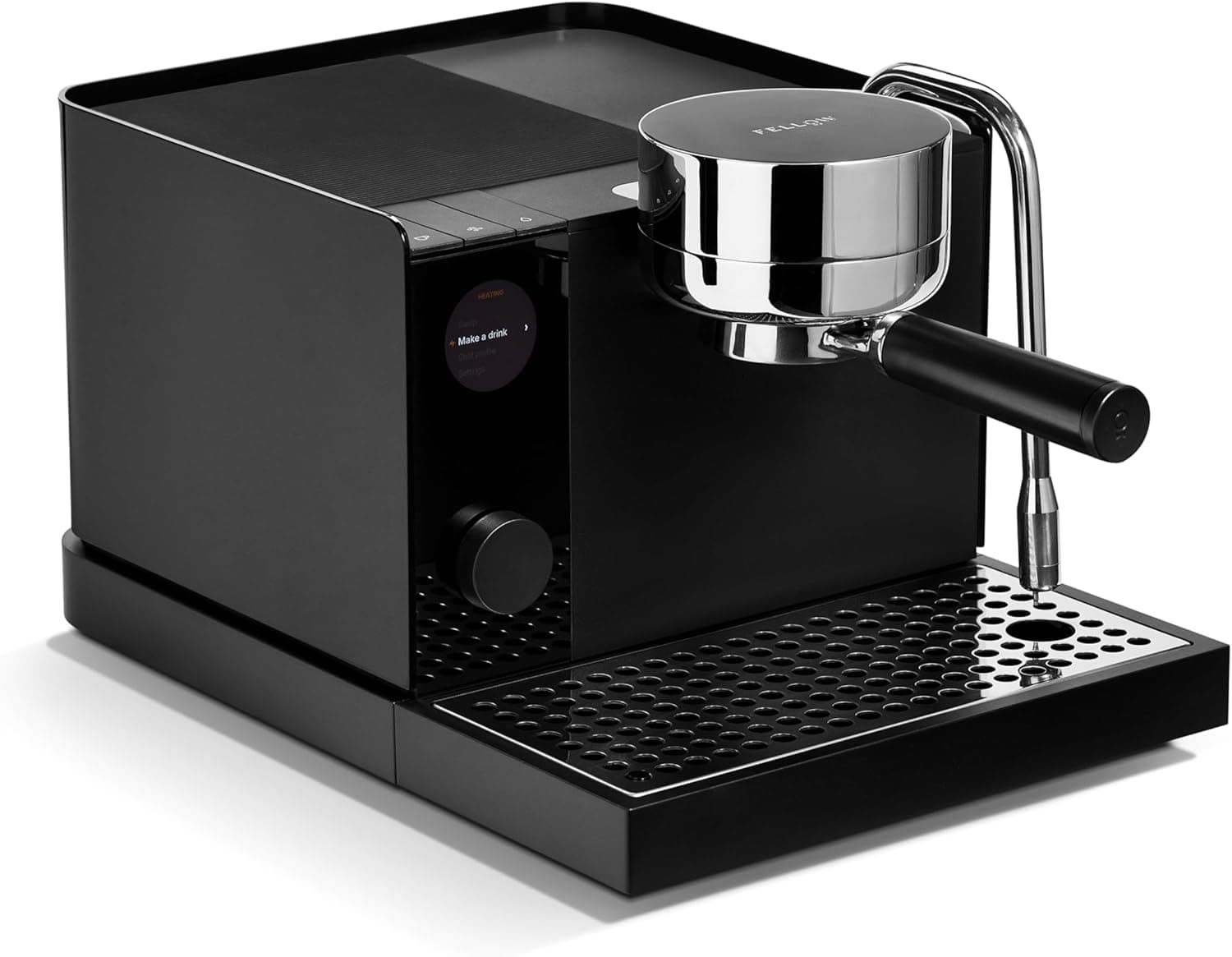
Fellow Espresso Series 1 specs at a glance
- Category: Semi-automatic, single-boiler espresso machine, no built-in grinder
- Heating: Proprietary "Boosted Boiler" system, a thermocoil-fed single boiler with an active group head heater
- Heat-up time: About 45 seconds from cold to brew-ready, per Clive Coffee
- Temperature control: No literal PID, per Tom's Guide; the Boosted Boiler system manages temperature through the shot instead
- Pressure profiling: Genuine, programmable, with presets and full custom profile building including ramp-down
- Interface: Full-color LCD screen with a navigation dial, showing real-time temperature, pressure, and timing
- Companion app: Create, save, and share custom profiles; all core brewing functions work fully without it
- Steam wand: Assisted, not fully manual or fully automatic, with a temperature probe and memory function
- Included accessories: Bottomless portafilter, tamper, marked steaming pitcher
- Pump: Vibratory, notably quiet for the type
- Design: Single-piece molded plastic chassis, exposed group head, available in multiple colors
- Market: Fellow's first espresso machine, described by at least one source as US-only at review time
One figure is worth flagging rather than restating quietly. This site's own product data lists heat-up time as "under 2 minutes," language that traces back to how Fellow and several retailers market the spec, and it's also how Amazon's own listing title phrases it. Clive Coffee, a specialty equipment retailer that covers the machine in more technical depth, puts actual heat-up at around 45 seconds from cold to brew-ready. Forty-five seconds is comfortably under two minutes, so the two figures aren't contradictory exactly, but "under 2 minutes" undersells what the Boosted Boiler actually does, and I'd rather flag that gap and recommend correcting the internal figure to ~45 seconds than let a vaguer, less specific number stand uncorrected.
The Boosted Boiler, and why it isn't a PID
Fellow's marketing leans on the Boosted Boiler name a lot, and it's worth being precise about what it is and isn't. It is not a PID controller, and Tom's Guide confirms that directly in its review. What it is: a thermocoil-fed single boiler paired with an actively heated group head, engineered so the system controls water temperature at every stage of the shot rather than just holding one setpoint. The practical effect lands close to PID-level consistency without the machine technically running one.
That distinction matters if you're the kind of buyer who goes shopping by spec sheet. A PID is a specific control mechanism; the Boosted Boiler is Fellow's own engineered approach to solving the same problem, temperature stability from pre-infusion through the end of the pull, using its own architecture instead. Whether you call it a PID or not doesn't change what happens in the cup, and the heat-up speed Clive Coffee measured, around 45 seconds, is fast enough that the usual complaint about single-boiler machines making you wait doesn't really apply here.
Pressure profiling: the actual differentiator
If there's one reason to read past the first section of this review, it's this. The Series 1 gives you genuine programmable pressure profiling: presets to start from, and full custom profile building if you want to shape the pressure curve yourself, ramp-down included. That means you can pre-infuse at low pressure, hold a plateau through the body of the shot, then taper off at the end, all defined ahead of time rather than fixed at whatever the pump delivers by default.
Multiple sources single this out as unusual at the price, and they're right to. Pressure profiling has historically lived on machines in the $2,000 to $5,000 range, the Decent Espresso and La Marzocco territory, because building a pump and control system flexible enough to vary pressure mid-shot isn't cheap. Fellow put that capability into a $1,500 machine on its first attempt at building one. For light roasts and washed single origins, the kind of coffee that channels or extracts unevenly under a fixed 9-bar hit, a slow-ramping profile is the difference between a shot that tastes sour and thin and one that develops properly. That's the feature the rest of the machine exists to support.
The app: useful, not required
Fellow built a companion app for the Series 1, and the honest way to describe the split is that it adds depth without gatekeeping function. Every essential operation, brewing, steaming, hot water, works completely without ever opening the app. What the app adds is the ability to build, save, and share custom pressure and brewing profiles, plus whatever updates Fellow pushes over time.
That's a sensible way to split the feature set. Someone who just wants to make a shot in the morning never has to touch a phone. Someone who wants to dial in a specific profile for a specific bag of Ethiopian natural, or copy a profile another Series 1 owner shared online, has a reason to open the app and a real use for it. It's an optional layer on top of a machine that already functions on its own, not a machine crippled without a companion device.
The steam wand: assisted, not automatic
Reviewers describe the Series 1's steam wand as "auto-ish," and that's a fair way to frame it. It isn't a fully manual wand where you're doing all the work, and it isn't a fully automatic system that textures milk hands-free either. A temperature probe and a memory function do real work: the machine tracks where the milk is heading and can recall settings you've used before, which takes some of the guesswork out of hitting a consistent temperature.
You're still positioning the wand, angling the pitcher, and shaping the texture yourself. If you're coming from a machine with a genuinely hands-free auto-steam system, this will feel like more involvement than you expected. If you're coming from a fully manual wand and dreading the learning curve, the temperature probe and memory function take real weight off that process. It sits in the middle, which is probably the right place for a machine built around giving you control rather than automating it away.
What's actually in the box
The Series 1 ships with a bottomless portafilter, a tamper, and a marked steaming pitcher, and reviewers describe all three as genuinely usable rather than the usual placeholder accessories you replace in the first week. A bottomless portafilter at this price stands out on its own: it's the tool that shows you channeling and uneven extraction directly, rather than hiding it behind a spouted basket, and it's normally an aftermarket purchase on machines that don't include one. Getting a set of accessories you don't need to immediately upgrade is a small thing, but it's a real one.
The honest reliability caveat
This is the part of a first-generation product review that's easy to soften, and I'd rather not. Coffeeness's review documents user reports of leaky hot water spouts and faulty 3-way solenoid valves on early Series 1 units, the kind of issues that show up when a company ships its first espresso machine rather than its tenth. That same coverage notes Fellow has been responsive, addressing bugs as they surface rather than letting them sit, and its own review unit didn't reproduce the water spout leak. That's a meaningfully different situation than a manufacturer that ignores a known defect, but it isn't the same as a clean bill of health either.
The fair way to read this: a first-generation product from a company with no prior espresso machine to iterate on carries more manufacturing risk than a fifth-generation Breville or a Gaggia design that's been refined for over a decade. Fellow's track record on the Ode grinder and the Stagg EKG kettle suggests a company that responds to feedback and fixes things, and the Coffeeness account is consistent with that pattern here too. But if rock-solid reliability out of the box is your top priority, go in knowing this specific machine's history rather than assuming a well-regarded brand name means a trouble-free first year.
Fellow Espresso Series 1 vs Breville Barista Pro
The Breville Barista Pro is the machine a lot of Series 1 shoppers are stepping up from, and the two solve different problems. The Barista Pro bundles a 30-setting grinder with Baratza-designed burrs on current units and a ThermoJet that heats in about 3 seconds, at a lower price. What it doesn't have is pressure profiling in any form: the pump delivers what it delivers, and there's no way to shape the curve.
The Fellow drops the built-in grinder entirely, so you're budgeting for a separate one on top of the machine's price, and its heat-up at around 45 seconds is slower than the Barista Pro's near-instant ThermoJet. What you get instead is the profiling itself, plus the Boosted Boiler's stage-by-stage temperature management. If you've outgrown a fixed-pressure machine and want the next real lever on extraction, the Fellow is built around exactly that lever. If a built-in grinder and the fastest possible heat-up matter more to you than shot-shaping, the Barista Pro remains the more complete package for less money.
Fellow Espresso Series 1 vs Gaggia Classic Pro
The Gaggia Classic Pro is the other natural comparison, since it shares the Fellow's BYO-grinder philosophy and its 58mm-adjacent commercial roots. The Classic Pro's E24 brass boiler is a genuinely well-regarded piece of engineering, and its 3-way solenoid valve and 58mm portafilter tap into a massive accessories and mod ecosystem built over more than a decade. It ships with no PID either, and the plastic included tamper is a real letdown at its price.
Where the Fellow pulls ahead is the feature set built in from day one: pressure profiling, the guided LCD interface, and an app-based profile system, none of which the Classic Pro offers even with mods. Where the Classic Pro pulls ahead is a track record: fifteen years of production, a documented mod community, and owner reports of machines lasting well over a decade. If you want a machine you can learn on for years and eventually modify yourself, the Classic Pro's maturity is a real asset. If you want pressure profiling out of the box without touching a soldering iron, the Fellow gets you there on day one, with a shorter ownership history behind it.
Who should buy the Fellow Espresso Series 1
Buy it if pressure profiling is a feature you'd actually use, not just a spec you'd like to have, you already own or are budgeting for a separate grinder, and you're comfortable being an early adopter of a first-generation machine from a brand with a strong record in adjacent products.
Skip it if you want a mature, multi-generation design with a long ownership track record, you need a built-in grinder to keep the total cost down, or a fully automatic steam wand is a requirement rather than a nice-to-have. The Barista Pro and the Classic Pro both serve those priorities more directly, just without the profiling.
Does the Fellow Espresso Series 1 have a PID?
No, not a literal PID controller, and Tom's Guide confirms this directly. Instead, the Series 1 uses Fellow's proprietary Boosted Boiler system, a thermocoil-fed single boiler paired with an actively heated group head, engineered to manage water temperature at every stage of the shot. In practice it targets similar consistency to what a PID delivers, using its own architecture rather than a traditional PID loop. The distinction shows up on a spec sheet comparison; it disappears once you're just judging what happens in the cup, since the Boosted Boiler is built specifically to solve the same problem.
Is the Fellow Espresso Series 1 reliable?
It's a first-generation product, and the honest answer reflects that. Coffeeness documented user reports of leaky hot water spouts and faulty 3-way solenoid valves on early units, and also noted Fellow has been actively addressing these issues as they've come up, with its own review unit not reproducing the leak. That's a better sign than a manufacturer that ignores known problems, but it's not the same as a long, clean reliability record either. Fellow's history with the Ode grinder and Stagg EKG kettle suggests a company that responds to feedback, and that pattern appears to be holding here, but this is still a first attempt at an espresso machine rather than a refined fifth or sixth generation design.
Does the Fellow Espresso Series 1 need the app to work?
No. Every core function, brewing, steaming, and hot water, works fully without ever connecting the app. The app's value is in building, saving, and sharing custom pressure and brewing profiles, plus receiving updates from Fellow. If you just want to pull a shot with the built-in presets, you never need to open it. If you want to fine-tune a profile for a specific bean or borrow one someone else built, that's where the app becomes genuinely useful.
What's included with the Fellow Espresso Series 1?
The machine ships with a bottomless portafilter, a tamper, and a marked steaming pitcher. Reviewers describe all three as genuinely usable out of the box rather than placeholder accessories most owners replace within the first week, which is a meaningful inclusion given that a bottomless portafilter is often a separate purchase on machines that don't include one. It does not include a grinder; that's a separate purchase by design, since the Series 1 is built around pairing with a dedicated burr grinder rather than one built in.