
Gevi Commercial Espresso Machine Review

Jack · Founder & Lead Reviewer
Researches every machine through engineering analysis, long-term owner reports, and independent technical testing, including Italian and German sources most English-language reviews skip.
Last updated
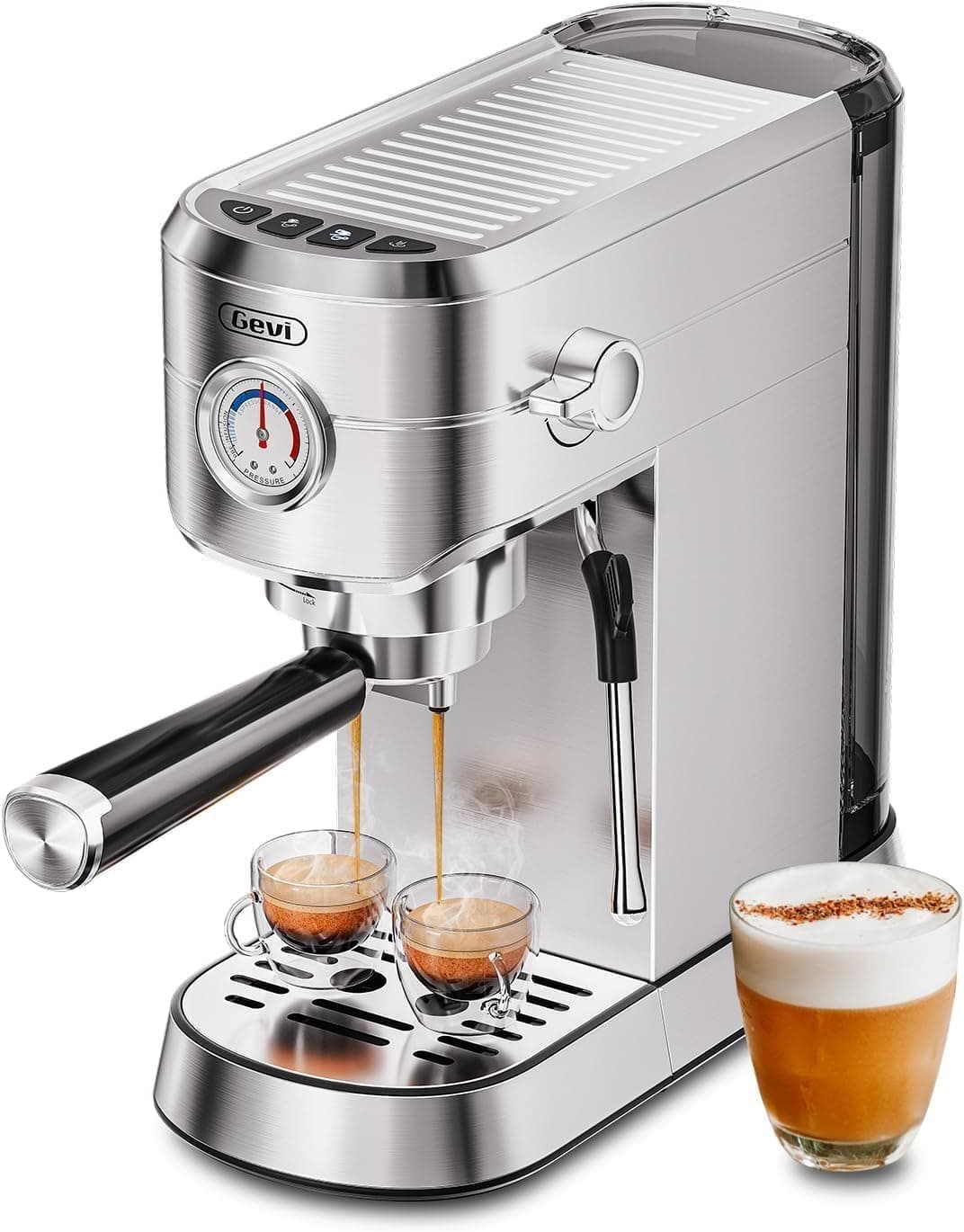
Is Gevi a good espresso machine brand? That's what this Gevi commercial espresso machine review is here to settle. The Gevi Commercial sits at around $130, less than two weeks of daily café stops for most people, and that's the right frame for judging it. Nobody searching that question is asking whether it competes with a Rancilio Silvia. They're asking whether it earns its keep at this price, and that one actually has a useful answer.
The verdict up front
The Gevi commercial espresso machine makes drinkable espresso-style coffee at a price that takes the stakes out of the decision. The 20-bar pump is real, the machine is compact, and an automatic milk frother does the work instead of asking you to learn wand technique. Reliability is inconsistent across units, and the word "Commercial" on the box is marketing language, not a literal description of what's inside. Rating: 3.8 out of 5.
Is Gevi a good espresso machine brand?
Honest answer: Gevi is a budget appliance brand that also makes coffee makers, ice makers, and blenders. Espresso machines are part of a wider catalog, not a specialist focus. The brand competes on price, not on component quality or brand prestige, and that's reflected in the machines.
Build quality on the Gevi Commercial is acceptable at its price point. The exterior carries stainless steel panels that look better than the price suggests, but the portafilter, drip tray, and internal components are mostly plastic. That's standard for machines in this price bracket, not a Gevi-specific failure.
Reliability is where the picture gets mixed. Many units run daily for a year or more without problems. A real subset develop leaks, reduced flow, or pump failures within the first year, consistent enough to factor into your decision. Budget appliance brands at this price tier carry that risk, and Gevi is no exception.
Here's the math that makes this acceptable rather than disqualifying: even if you replace this machine after 18 months, you've spent roughly $130. Two years of daily café espresso costs significantly more. The replacement calculation changes entirely at this price.
3.8What you get
Per Gevi's spec sheet, this machine punches above its price in a few places. A 20-bar pump is the headline, and it's real: this is a pump machine, not a steam-pressure toy, and machines without a real pump can't reach espresso extraction pressure regardless of what the marketing says.
Four adjustable brewing volume options replace the usual single/double toggle, pre-infusion wets the puck before full pressure kicks in, and a pressure gauge lets you watch extraction happen instead of guessing. Temperature runs off an NTC sensor rather than a full PID loop, so this isn't the precise, multi-point temperature control you'd get on a pricier machine, but it's more than most machines at this price bother with.
The portafilter takes traditional ground coffee, runs bottomless if you want to watch the shot pull, and also accepts ESE pods and Nespresso-style capsules, a wider range of formats than most machines in this bracket support.
Milk goes through an automatic frother rather than a manual wand. Gevi markets it as hands-free: point it at your pitcher, start the cycle, and it handles the rest. It also dispenses hot water, useful for an americano or a cup of tea without heating a separate kettle. Stainless steel panels wrap the body, and the compact footprint fits comfortably on a small kitchen counter, dorm desk, or office break room surface without dominating the space.
One thing worth naming directly: this machine is sold under the "Commercial" label. That word describes nothing about how the machine is built. It's a budget home machine. The portafilter, baskets, and boiler aren't commercial-grade components by any standard definition. Knowing this going in prevents disappointment later.
How the espresso tastes
Realistic expectations are the right frame here. The Gevi won't pull shots that rival a De'Longhi Stilosa with freshly ground beans, let alone anything further up the price ladder.
The pressurized double-wall baskets produce consistent foam-topped espresso-style coffee from pre-ground supermarket beans. The foam is real, but it isn't crema in the technical sense. Pressurized baskets create that foam through mechanical back-pressure, so even stale or coarsely ground coffee comes out looking the part. Real crema forms naturally from fresh, correctly ground coffee under a non-pressurized basket, and that's a different animal entirely.
What it does produce is a hot, balanced cup with enough body to work in a cappuccino or latte. For someone who has never used a portafilter machine and wants to know what the home espresso experience is like, this delivers an honest version of that at minimum investment. Drinkable. Often better than expected. Not a ceiling anyone serious about espresso will stay under for long.
Pre-ground coffee performs fine here. A burr grinder improves results noticeably, but it's not required the way it becomes on machines with non-pressurized baskets.
The milk frother
Milk works differently on this machine than on most machines this cheap. Instead of a manual wand you point and hold, Gevi built an automatic frother: position your pitcher, start the cycle, and it runs on its own, no need to learn wand angle or immersion depth by trial and error. It also dispenses hot water on demand, and the nozzle is removable, which makes cleaning it easier than fishing dried milk out of a fixed steam tip.
The tradeoff of any automatic system is control. A manual wand lets an experienced hand shape microfoam by feel, adjusting depth and angle mid-pour to dial in texture for latte art. An automatic cycle can't do that; it runs its program regardless of what the milk is doing underneath it. That likely means consistent, usable foam for cappuccinos and lattes with no learning curve, but it also means no path to the fine microfoam a manual wand can produce in skilled hands. A motorized frothing mechanism is also one more moving part that can fail, another line item to factor into the reliability picture alongside the pump and boiler.
For someone who doesn't want to spend weeks learning steam technique, trading that ceiling for convenience is a reasonable deal. For someone chasing latte art, this isn't the machine that gets you there.
Where it falls short
Three things worth naming clearly before you buy.
The frother won't get you latte art. It's automatic, hands-free, and dispenses hot water too, which is genuinely convenient. But an automatic cycle can't shape microfoam the way an experienced hand on a manual wand can. If fine latte art is the goal, look elsewhere.
"Commercial" is marketing language. The product name includes the word "Commercial," but that says nothing about the machine's components, build standard, or intended use environment. This is a budget home machine with stainless panels wrapped around a mostly plastic chassis. Go in expecting commercial-grade internals and disappointment follows.
Reliability is inconsistent. Not every unit has problems, but leaks, flow issues, and pump failures within the first year are real possibilities at this price tier. The math still works out around $130. Just don't expect it to last a decade the way a Rancilio Silvia would.
Budget machines at this price often ship with thin manuals. If you've never used a portafilter machine before, plan on YouTube for the setup details the included instructions skip.
How to use, clean, and descale it
Using it: Fill the tank, insert the portafilter with a pressurized basket, choose one of the four brew volumes, and wait for it to heat, roughly 30–40 seconds. Press start and watch the pressure gauge climb as the shot pulls. For milk, position your pitcher under the frother and start the automatic cycle; it handles depth and timing on its own. Wipe the nozzle once it's done.
Daily cleaning: Knock the puck, rinse the portafilter and basket under hot water, and wipe the frother nozzle before milk residue dries on it. It takes under two minutes. Don't skip the wipe; dried milk clogs the nozzle faster than you'd expect.
Descaling: Every one to two months, depending on your water hardness. The descaling calculator gives you a more precise interval based on your water and daily cups. Use a commercial descaling solution or diluted food-grade citric acid, not vinegar, which leaves residue behind. Run the solution through the boiler following the manual's cycle instructions, then flush twice with clean water. The how to descale an espresso machine guide covers the full process step by step if you want more detail.
Who should buy the Gevi commercial espresso machine?
Buy it if you've never owned an espresso machine and want to find out whether you'll use one, your budget is firm under $150, you have a small kitchen or need something compact for a dorm or office, or you want a low-stakes backup machine.
Skip it if you want hands-on control over milk texture, a machine with a reliable multi-year track record, or build quality that holds up to daily use over several years. At that point the De'Longhi Stilosa costs slightly more and is a meaningful step up. Save further and look at the Breville Bambino Plus; past that point, the machines are genuinely different instruments.
The best espresso machines for beginners guide covers the full spectrum from ultra-budget machines like this one up through the options worth buying if you're serious about espresso.
Frequently asked questions
Is Gevi a good espresso machine brand?
Gevi is a budget appliance brand, not a specialist espresso company. Their machines compete on price and are acceptable for first-time owners at entry-level budgets. Reliability is mixed: many units run trouble-free for a year or more, while a real subset develop early failures. At under $130, the value calculation is different than it would be at $400: even replacing the machine after 18 months still costs less than a few months of daily café espresso.
How long do Gevi espresso machines last?
It varies. Many units run daily for one to two years without problems. Leaks, pump issues, or reduced flow within the first year are real possibilities at this price tier. Setting expectations at one to two years of reliable use is realistic. At this price, lasting a decade like a Rancilio Silvia or Gaggia Classic Pro isn't a fair benchmark.
How do you descale a Gevi espresso machine?
Every one to two months, depending on water hardness. Mix a commercial descaling solution (or diluted food-grade citric acid) with water per the solution's instructions and run it through the machine's boiler cycle. Follow with two flush cycles using clean water to remove all residue. Check your specific model's manual for the exact button sequence to start the descaling mode, as it varies by model number.
Is the Gevi espresso machine good for beginners?
Yes, with the right expectations. The machine is simple to operate, the pressurized baskets are forgiving with pre-ground coffee, and the automatic frother means there's no wand technique to learn, genuinely useful for someone who has never made milk drinks before. Treat it as a starting point: if you find yourself using it daily and wanting more control over your milk texture or shot quality after six months, that's your signal to invest in a pricier machine.