
Chefman CraftBrew Espresso Machine Review

Jack · Founder & Lead Reviewer
Researches every machine through engineering analysis, long-term owner reports, and independent technical testing, including Italian and German sources most English-language reviews skip.
Last updated
 3.7
3.7
This Chefman CraftBrew review exists because the machine sits at the very bottom of the price range for anything with a real steam wand, and it claims to make espresso at home with a genuine 15-bar pump. At that price, the question isn't whether it performs like a $700 machine. The question is whether it's good enough to replace the daily coffee shop trip for someone who just wants espresso or a basic cappuccino without a serious investment.
Two things to know before anything else. Chefman has a documented quality-control inconsistency problem across its espresso lineup: some units arrive defective, and the failure rate in owner feedback is higher than you'd see from more established brands. And the pump noise is real. Multiple owners across multiple Chefman models describe the CraftBrew as loud during extraction. Neither is a dealbreaker at this price, but both are worth knowing going in.
The verdict up front
For what it is, the CraftBrew looks like a reasonable first machine on paper. It's built around a real 15-bar pump and a manual steam wand rather than a novelty steam-pressure toy, and the low price removes most of the financial risk from trying home espresso for the first time.
Which Chefman model is this? (clearing up the lineup)
Chefman sells several espresso machines with similar names. It's easy to order the wrong one.
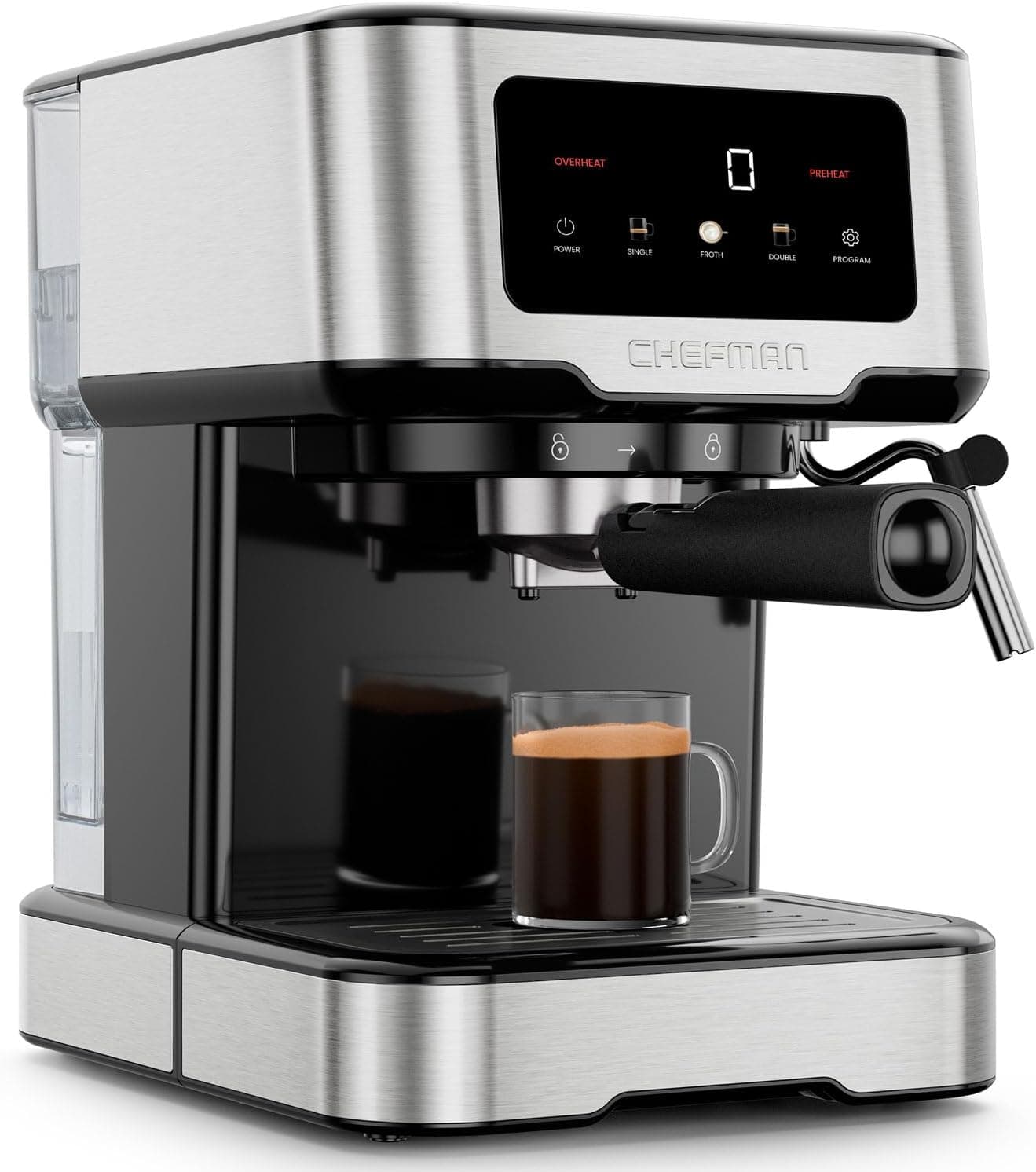
The Chefman CraftBrew (this review), model RJ54-SS-15-D, is the most compact and affordable in the lineup. Manual steam wand, 1.5L removable water tank, touch panel, priced well under $100. This is the entry-level model.
The CaféMaster Pro steps up to an automatic milk frother that dispenses steamed milk straight into your cup, a larger 1.8L tank, and a noticeably higher price. The Chefman CaféMaster Pro review covers that model in detail. If the manual steam wand is what's stopping you from buying the CraftBrew, the CaféMaster Pro solves that entirely.
The Barista Pro 6-in-1 and Crema Supreme are separate product lines with different specs and layouts. Searches for "chefman barista pro espresso machine" or "chefman crema supreme espresso machine" will pull up listings that have nothing to do with this review.
The CraftBrew is the right choice if manual frothing and a lower price are what matter. The CaféMaster Pro is the right step up if you want one-touch automation and a bigger tank.
What you get
Fifteen-bar pump. A 1.5-liter removable water reservoir. A manual steam wand. A touch control panel with adjustable shot volume and brew time. A stainless steel finish that Chefman says wipes clean easily. At roughly 10.8 x 8.9 x 11.9 inches and about 7.9 lbs, it's small enough for a compact kitchen counter. It runs on 1350W at 120V.
The box includes the portafilter, single and double shot baskets, a coffee scoop, a tamper, and a user guide. The machine is cETL approved and carries a 1-year warranty from Chefman. An auto descaling alert triggers after 500 brew cycles, and the drip tray is removable for cleaning.
The 15-bar figure is the pump's maximum pressure rating. Actual extraction pressure at the puck is lower, regulated down by the machine's internals to around 9 bar, which is standard for espresso. The pressurized portafilter basket does the work of making shots consistent despite varying grind quality, which is genuinely useful for beginners who aren't yet using a precise burr grinder.
The Chefman CraftBrew portafilter isn't listed on the official spec sheet, but a Chefman representative answered a customer's question on Best Buy with a diameter of 59mm. Treat that as the best available answer rather than an official spec, since Chefman hasn't published the figure itself. Aftermarket baskets in that size are worth checking against your unit before ordering, given how many near-identical Chefman models are on the market.
How the espresso tastes
The double-shot basket is pressurized, which is standard at this price and forgiving of pre-ground coffee or an inconsistent grind. Put in a reasonable dose, tamp lightly, press the button, and the basket's back-pressure does most of the work of producing a consistent-looking shot regardless of grind quality. It won't reward dialing in extraction ratios with a precise burr grinder, but it won't punish basic technique either. For someone buying pre-ground coffee or using a modest blade grinder, that forgiveness is the whole point, and it's consistent enough for a milk drink, which is likely what most buyers are making.
Temperature is the reported weak spot. Owners describe back-to-back shots coming out noticeably cooler than the first, and some say even the initial shot isn't as hot as they'd expect. Straight espresso drinkers who care about serving temperature should factor that in.
The steam wand
The manual steam wand is what separates the CraftBrew from a capsule machine. It also requires time to learn.
Purge the wand before each use: open the steam valve briefly to clear any condensate, then close it again. Submerge the tip just below the milk surface, slightly off-center so the milk rotates. For stiffer cappuccino foam, keep the tip near the surface. For a flatter latte texture, push the tip deeper as the milk heats. Close the valve around 140–150°F, wipe the wand with a damp cloth, and purge once more.
Expect the first several attempts to produce more large bubbles than you'd like, that's normal for any manual wand. Owner reports back that up: most describe usable cappuccino foam within a couple of weeks of daily practice. Latte art quality isn't realistic from this wand, but a good home cappuccino is a reasonable target.
If you want push-button milk with no technique required, the CaféMaster Pro is the better choice, at a meaningfully higher price. The CraftBrew rewards the additional effort with more hands-on control over the texture of your milk.
Where it falls short
Noise and vibration during brewing are the most consistent owner complaints across Chefman's espresso lineup, and the CraftBrew is no exception. Owners describe the pump as audible throughout extraction, and say the machine vibrates enough to move on the counter if you don't have a textured mat underneath it. If noise is a real concern in your kitchen, it's worth knowing before buying.
Quality-control inconsistency is the more significant problem. Owner reviews across Chefman's lineup document defective units at a higher rate than more established espresso brands. Some CraftBrew owners report a year or more of daily use with no issues. Others report failures within the first few months. The replacement cost is low at this price, and the 1-year warranty covers defective units. But going through a replacement process for a machine that arrived broken is an inconvenience no warranty fully compensates for.
Build quality is what you'd expect for the price. The stainless steel finish covers a mostly plastic, lightweight body, with seams that don't fit as tightly as a pricier machine's chassis would. The exterior picks up fingerprints and scratches faster than a fully metal-bodied machine. None of this is a surprise at this price, but it's visible the first time you handle the machine.
How to use, descale, and troubleshoot it
Basic startup: fill the 1.5L reservoir and seat it firmly until it clicks into place. Pack the portafilter basket with ground espresso and tamp lightly. Lock the portafilter into the group head, select single or double on the touch panel, and press brew.
For the steam wand: purge before use, submerge just below the milk surface, texture for 20–30 seconds, then wipe and purge again immediately. Milk residue on the wand dries fast and is harder to remove if you let it sit.
Descaling should happen every one to two months depending on your water hardness, or when the auto descaling alert triggers after 500 brew cycles. Mix a standard espresso descaling solution with water per the product instructions, fill the reservoir, and run it through the full cycle. Follow with two full tanks of clean water to flush all residue.
Two troubleshooting issues appear most often in owner forums. For "not pumping water": the reservoir is almost certainly not fully seated. Remove it, check the contact point for debris, and reseat it firmly until it locks. Wait for the warm-up cycle to complete before brewing. For "frother not working": check the steam wand tip for milk residue blocking the steam hole. A sewing pin or a dedicated wand cleaning needle clears it in seconds. Replacement parts and portafilter baskets are available through Chefman's website and select retailers.
CraftBrew vs CaféMaster Pro: which Chefman to buy?
This is the comparison most buyers are actually making between these two models.
The CraftBrew is the cheaper of the two: manual steam wand, 1.5L tank, smaller footprint, and you develop the frothing technique yourself. The CaféMaster Pro costs meaningfully more and swaps in an automatic milk system with a larger 1.8L tank: one button, and milk dispenses directly into the cup.
Both use pressurized baskets. Neither is built for dialing in espresso extraction. The decision is almost entirely about workflow preference and budget. If you're willing to learn a steam wand and want to spend less, the CraftBrew makes sense. If you want one-touch lattes without any technique development, paying more for the CaféMaster Pro is the right call. There is no scenario where the CraftBrew makes better espresso than the CaféMaster Pro. The hardware underneath is comparable. The difference is entirely in the milk system.
Who should buy the Chefman CraftBrew?
Buy it if: you want one of the cheapest real steam wand espresso machines you can find, you're testing home espresso without committing serious money, or you have a small kitchen where footprint is a constraint. At this price, getting it wrong and moving on isn't a significant financial loss.
Skip it if: you want push-button milk automation and don't want to practice steam technique, you've read about the quality-control issues and want a more consistent track record, or you'd prefer a machine with more documented long-term reliability. The De'Longhi Stilosa is worth a close look at a similar price for a brand with a stronger track record in this segment. The best espresso machines under $200 guide covers both alongside everything else at this price tier.
What's the difference between the Chefman CraftBrew and CaféMaster Pro?
The CraftBrew has a manual steam wand and a 1.5L water tank, and it's the cheaper of the two. The CaféMaster Pro has an automatic milk frother that dispenses steamed milk straight into your cup, a larger 1.8L tank, and costs meaningfully more. Both use pressurized baskets. The difference is the milk system: the CraftBrew requires you to learn steam wand technique, while the CaféMaster Pro removes that step entirely. Choose the CraftBrew if you want to develop the manual skill and spend less. Choose the CaféMaster Pro if you want one-touch lattes without any frothing practice.
Why is my Chefman espresso machine not pumping water?
The most common cause is a reservoir that is not fully seated. Remove the 1.5L tank, check the connection point for debris or a misaligned seal, and reseat it firmly until it clicks into place. Wait for the full warm-up cycle to complete before attempting to brew. If pumping still fails after reseating, try a purge cycle to clear any air lock in the water path. Persistent pump failure after these steps typically points to a defective unit, which is covered by the 1-year warranty.
How do you descale a Chefman CraftBrew?
Mix a standard espresso machine descaling solution with water per the product instructions and fill the 1.5L reservoir. Activate the descale mode on the machine (the indicator light signals when descaling is due). Run the full descaling solution through the cycle, then follow with two full tanks of clean water to flush all residue before brewing. Descale every one to two months depending on your water hardness. Using filtered water between descaling cycles slows mineral buildup and extends the interval.
Is the Chefman CraftBrew good for beginners?
Yes, with realistic expectations. The pressurized basket is forgiving with pre-ground coffee, so you don't need a precise burr grinder to get a drinkable shot. The manual steam wand does require practice: plan for a couple of weeks before your foam is consistently good enough for a home cappuccino. The main beginner risk is the quality-control inconsistency across Chefman's lineup, meaning some units arrive defective. The financial risk is low at this price and the warranty covers defects, but it's worth knowing. If you want a more established brand at a similar price, the De'Longhi Stilosa is the most common alternative.