
Chefman CaféMaster Pro Review (2026)

Jack · Founder & Lead Reviewer
Researches every machine through engineering analysis, long-term owner reports, and independent technical testing, including Italian and German sources most English-language reviews skip.
Last updated
 3.9
3.9
Most budget espresso machines make you work for your latte. Manual steam wand. Timing the froth yourself. Hoping the milk doesn't scorch. The Chefman CaféMaster Pro skips all of that: fill the attached carafe with cold milk, press one button, and steamed milk flows straight into your mug alongside the shot. At around $150, the real question isn't whether it makes precise espresso. It's whether that automation is worth the trade-offs.
Two things to know before anything else. First, Chefman has a documented quality-control inconsistency problem across its espresso lineup. Not every unit is affected, and plenty of owners report years of trouble-free use. But defective units appear more frequently in owner feedback than you'd expect from a more established brand. Second, the build quality is basic up close: light plastic housing, finishes that show wear faster than a metal chassis would, components that feel correspondingly budget at every touchpoint. Neither automatically makes this a bad buy. Both are things you should factor in before clicking purchase.
The verdict up front
The CaféMaster Pro is a good fit for one specific buyer: someone who wants automated milk drinks, has no interest in pulling precision espresso, and is price-limited to around $150. It is not the right machine for anyone who wants to learn extraction or dial in shots.
Which Chefman is this? (the confusing lineup)
Chefman sells a confusing number of espresso machines with overlapping names and similar specs. Before spending money, it is worth knowing which one you are actually looking at.
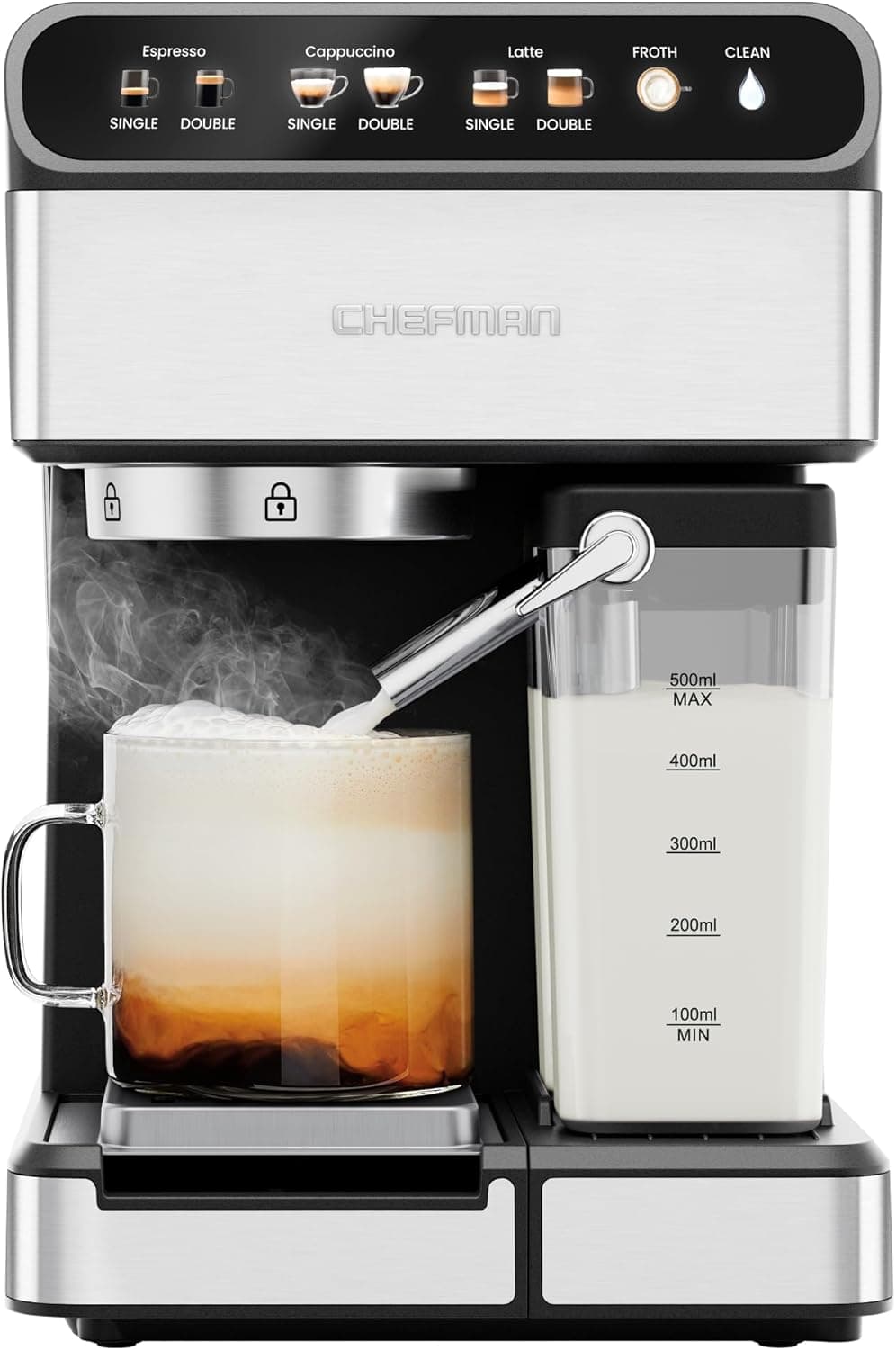
The CaféMaster Pro (this review) is the model with the automatic milk frother, a 1.8L removable water tank, and one-touch digital controls for single espresso, double espresso, cappuccino, and latte. The detachable carafe connects to the machine's internal pump and dispenses steamed milk directly into the cup. That feature is the primary reason to choose this model over any other Chefman option.
The CraftBrew is more compact, runs a 1.5L water tank, and uses a manual steam wand instead of the automatic frother. If you search "chefman craft brew espresso machine," you are looking at a different product with a different workflow. The CraftBrew suits someone comfortable with a manual wand who wants a smaller machine. The CaféMaster Pro is for someone who wants the automation.
The Barista Pro 6-in-1 runs a similar automatic frothing setup to the CaféMaster Pro. Comparing listings, the functional difference between these two models is small. Check both prices before committing.
The Crema Supreme is a separate product line entirely with different hardware and design. Searches for "chefman crema supreme espresso machine" land on something distinct from this review.
What makes the CaféMaster Pro different
The headline feature is the automatic milk system, and it is worth understanding how it actually works. A separate carafe attaches to the side of the machine and connects to an internal pump. Select your drink on the touch panel and the machine pulls the shot and dispenses frothed milk directly into the mug sitting below the spout. No wand. No separate step. No timing judgment required. The one-touch panel covers six drink options in total: single and double espresso, cappuccino, latte, and a couple of other preset pours, the "6-in-1" functionality Chefman lists on the box.
For daily use, the logistics are simple. Fill the carafe with cold milk before brewing. Attach it, select your drink, press start. The machine handles the rest. Chefman recommends removing the carafe and storing it in the refrigerator between sessions, which matters for food safety and keeps residue from building up inside the attachment.
The 15-bar pump produces genuine extraction pressure, not the steam pressure found in sub-$100 machines. The 1.8L water tank is removable for filling or cleaning at the sink and holds enough for several drinks before a refill, practical for a two-person household. The built-in cleaning function runs a rinse cycle through the milk path at the press of a button. Including that at this price tier is a genuinely useful decision, not a feature list filler.
The box includes a coffee scoop, tamper, drip tray, single and double shot baskets, and the milk frother carafe, everything needed to start brewing without buying accessories separately. The housing is stainless steel on top of BPA-free construction, and there's a flat surface on top for storing cups or accessories. It's cETL approved and comes with a 1-year warranty from Chefman.
How the espresso tastes
Pressurized baskets are standard at this price, and the CaféMaster Pro uses them. The restricted exit hole generates back-pressure that produces a foam-topped shot regardless of grind quality or tamping technique. The visual result looks like crema, but it isn't crema in the way the word is used for a properly extracted shot: that foam comes from mechanical restriction in the basket, not from oil correctly emulsified under the right pressure and grind.
For milk drinks, that distinction matters less than it sounds. Whatever flatness a pressurized basket introduces gets diluted once 4–6oz of steamed milk goes into the cup, which is the whole reason pressurized baskets remain standard on machines built around milk drinks rather than straight shots. Flavor issues that would stand out in a black double shot are largely masked in a cappuccino or latte.
Some owners report the coffee does not always come out as hot as they'd like. Machines at this price tier vary in temperature output, and the CaféMaster Pro is not an exception. For milk drinks, this matters less than it would for straight espresso. Anyone planning to drink shots black should know the machine isn't built around extraction temperature precision.
The automatic frother: the real selling point
This is why most buyers choose the CaféMaster Pro over the CraftBrew or a cheaper Chefman option. The carafe system removes the hardest part of making milk drinks at home: managing a steam wand without burning your fingers or over-aerating the milk.
Fill the carafe, attach it, select your drink, and the frother does the rest. Chefman built it to skip the learning curve entirely: you aren't developing a skill here, you're pressing a button. What owners actually get from that button press is less uniform than the pitch suggests. Plenty describe usable, frothed milk that works fine for a home cappuccino or latte. Others describe inconsistent results from one drink to the next, and some report the frother and shot both coming out warm rather than properly hot, or a flavor that leans plastic or metallic rather than rich, particularly on machines that haven't been cleaned or descaled on schedule.
Long-term reviews also mention frothing quality degrading over time on some units. Whether that's a maintenance issue or a durability one isn't clear from available feedback. Running the built-in cleaning cycle after every milk session is the strongest mitigation available, and ease of cleaning (the internal cycle plus a removable drip tray) is one of the more consistent positives in owner reviews. Keeping the carafe chilled between uses, as Chefman recommends, also reduces residue buildup inside the attachment.
Where it falls short
Quality-control inconsistency is the most significant concern with this machine, and being direct about it is more useful than burying it at the end. Owner reviews for Chefman's espresso lineup contain multiple reports of defective units received at delivery. One Walmart reviewer documented two defective units of a related model within five months. That is not an isolated report; it is a recurring pattern across several models in the lineup and across multiple retailers.
To be fair: many Chefman owners report trouble-free use over years of daily brewing. The inconsistency is not "every unit fails." It is "the quality floor is lower than it should be, and you might draw the short straw." The 1-year warranty covers defective units, but going through a replacement process is an inconvenience that more reliable brands don't impose.
Noise and vibration during brewing appear consistently in owner feedback across this machine and Chefman's closely related Barista Pro sibling: multiple owners describe the machine as loud while brewing, and note it can shake or vibrate on the counter. That's within the normal range for budget machines, but it's worth setting expectations before buying.
The build quality reflects the price. Stainless steel covers the exterior, but underneath that, expect light plastic housing, misaligned seams, and finishes that scuff and discolor faster than a metal chassis would. None of this is surprising at this price, but handling the machine makes the budget tier tangible in a way that photos do not convey.
How to use, clean, and descale it
Basic startup is simple. Fill the 1.8L tank and seat it firmly until it clicks into place. Fill the milk carafe with cold milk and attach it to the machine. Place a mug under the dual spouts, select your drink from the touch panel, and press start.
For the built-in cleaning function: press and hold the clean button after each milk-drink session. The machine runs a rinse cycle through the milk system automatically. Detach the carafe after each use and refrigerate it, as Chefman recommends. Wipe the exterior with a damp cloth. Running the cleaning cycle consistently after every milk session is the single most important maintenance habit on this machine.
Descaling should happen every one to two months depending on your water hardness. Mix a standard espresso descaling solution with water per the product instructions, fill the tank, and run the descale cycle. Follow with two full tanks of clean water to flush all residue. The indicator light signals when descaling is due.
Two troubleshooting issues show up consistently in owner forums. For "not pumping water": check that the reservoir is fully and firmly seated. A partially seated tank is a common cause. Reseat it, wait for the full warm-up cycle, and try again. For "frother not working": check the carafe attachment connection first, then run the built-in cleaning cycle. A blocked milk path accounts for a fair share of frother complaints before any defect is involved. Replacement parts and baskets are available through Chefman's website and select retailers; check the exact fit against your unit before ordering, since Chefman's near-identical models don't all share the same portafilter dimensions.
Who should buy the Chefman CaféMaster Pro?
Buy it if: you want automatic milk frothing without learning a steam wand, you are primarily making lattes and cappuccinos rather than straight espresso, and around $150 is the price ceiling you are working within. The large water tank and one-touch operation genuinely deliver on their promises for that use case.
Skip it if: you want precise control over espresso quality, you have read about the quality-control issues and want to wait for a more consistent track record, or you prefer a brand with a longer established presence in this category. At a similar budget, the De'Longhi Stilosa is a more proven entry-level option with a longer documented history behind it. If your budget stretches toward $200, the Gevi Commercial Espresso Maker offers meaningfully better build quality and is worth serious consideration. For a broader look at what is available in the budget segment, the best espresso machines under $200 guide puts both in context.
What's the difference between the Chefman CaféMaster Pro and CraftBrew?
The CaféMaster Pro has an automatic milk frother: a detachable carafe that connects to the machine's pump and dispenses steamed milk directly into your cup at the press of a button. The CraftBrew uses a manual steam wand instead and runs a smaller 1.5L water tank compared to the CaféMaster Pro's 1.8L. The CraftBrew suits someone comfortable with a manual wand who wants a more compact machine. The CaféMaster Pro is for someone who wants one-touch milk drinks with no wand technique required. If the automatic frother is what drew you to this model, the CaféMaster Pro is the right choice. If you would rather develop the manual skill and save counter space, the CraftBrew is the better fit.
Why is my Chefman espresso machine not pumping water?
The most common cause is a water reservoir that is not fully seated. Remove the 1.8L tank, check the connection point for debris or a misaligned seal, and reseat it firmly until it clicks. If the machine just started, wait for the full warm-up cycle to complete before brewing. If pumping still fails after reseating the tank, run the built-in cleaning cycle to clear any blockage in the water path. Persistent pump failure after these steps typically points to a defective unit, which is covered under the 1-year warranty.
How do you descale a Chefman espresso machine?
Mix a standard espresso machine descaling solution with water per the product instructions and fill the water tank. Activate the descale mode when the indicator light signals it is due. Run the full descaling cycle through the machine, then follow with two full tanks of clean water to flush all residue. Descale every one to two months depending on your water hardness. Using filtered water between descaling cycles extends the interval and protects the internal components from mineral buildup.
Is Chefman a reliable espresso machine brand?
Mixed. Many Chefman owners report years of trouble-free daily use. However, quality-control inconsistency is a documented pattern across the espresso lineup, with defective units appearing more frequently in owner reviews than you would see from De'Longhi, Breville, or Gaggia at comparable price points. The 1-year warranty covers defective units if you receive one. If long-term reliability is the priority, brands with longer and more consistent track records in this category are worth the price difference. The Chefman CaféMaster Pro makes the most sense as a budget-first buy where the automatic frother feature is the deciding factor.